
Why production readiness is really about state, recovery, governance and controlled failure.
There is a question I increasingly want leaders to ask when a data team says a pipeline is “done”:
What exactly happens when it fails at 2:13 a.m.?
Not whether the transformation works. Not whether a notebook can read a file, join two DataFrames and write a Delta table.
What happens when a source sends duplicate events? When yesterday’s record arrives after today’s? When a schema changes unexpectedly? When half a transformation completes and compute disappears? When an engineer leaves the organization but the production job is still running under that person’s identity?
And perhaps most importantly: can we prove what happened afterward?
That is where the distinction between data engineering code and a production data pipeline becomes important.
I have seen enough enterprise technology programs to be cautious when a demonstration becomes mistaken for an operating capability. A successful notebook run can create exactly that problem. The output looks right, the architecture diagram looks modern, and the project appears much closer to production than it really is.
It is not necessarily bad engineering. It is often a failure to distinguish transformation logic from the production system around it — a distinction that becomes particularly important on platforms such as Azure Databricks, where several powerful capabilities can make development deceptively easy.
The mental model I use is simple:
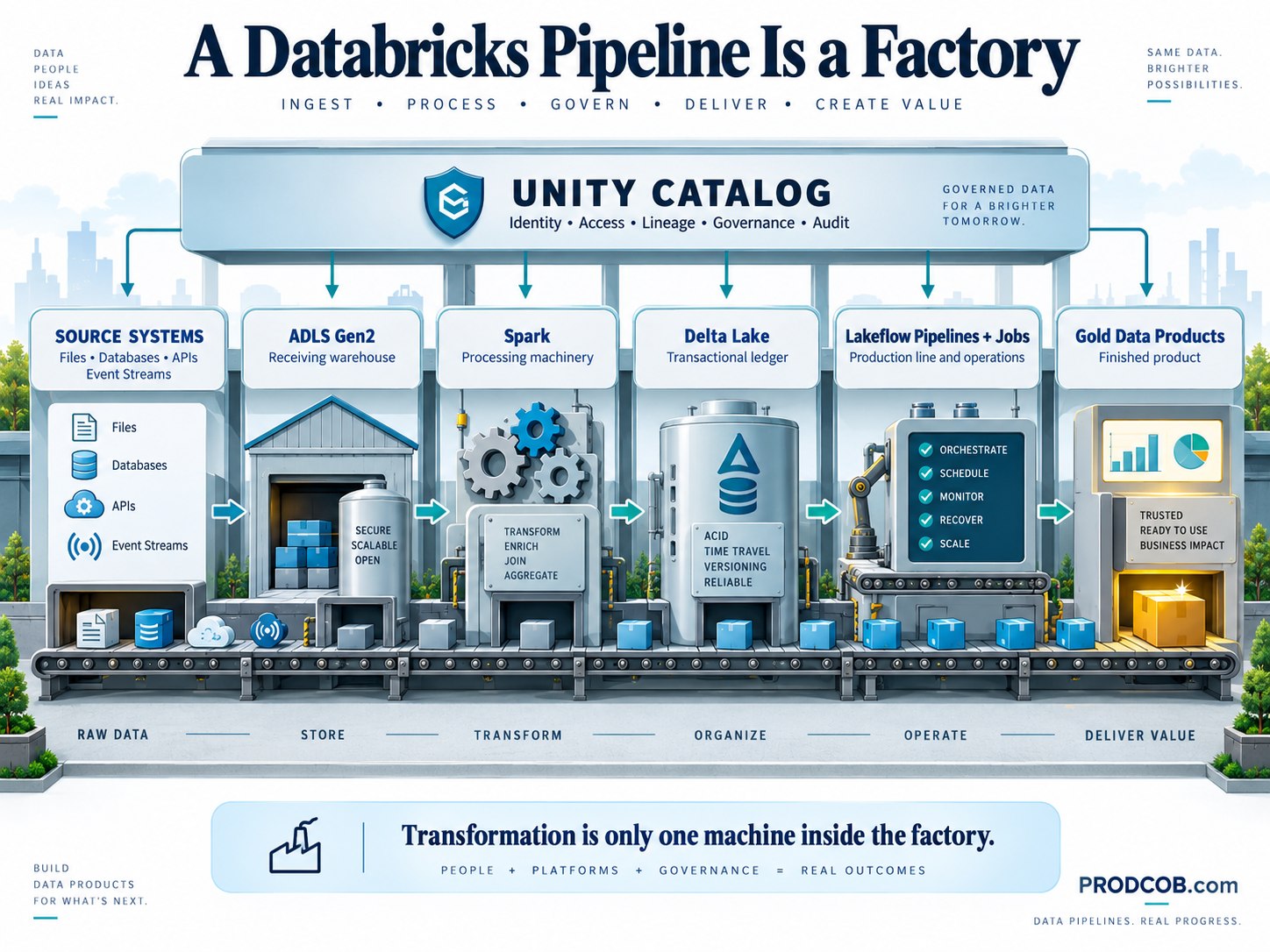
A production data pipeline is a factory, not a script.
- ADLS holds the incoming goods.
- Spark operates the machinery.
- Delta Lake maintains the transaction ledger.
- Lakeflow operates and coordinates the production line.
- Unity Catalog controls who can enter, what they can touch, and what can be traced afterward.
The transformation code matters. But it is only one part of the factory.
Why the Notebook Creates False Confidence
Consider what a typical early data-engineering demonstration looks like. A developer loads a file. The notebook removes bad records. It joins reference data. It aggregates the result. It writes the output. The numbers look correct.
From a functional standpoint, the exercise may be completely successful. The problem begins when leadership interprets that success as evidence that the pipeline itself is ready.
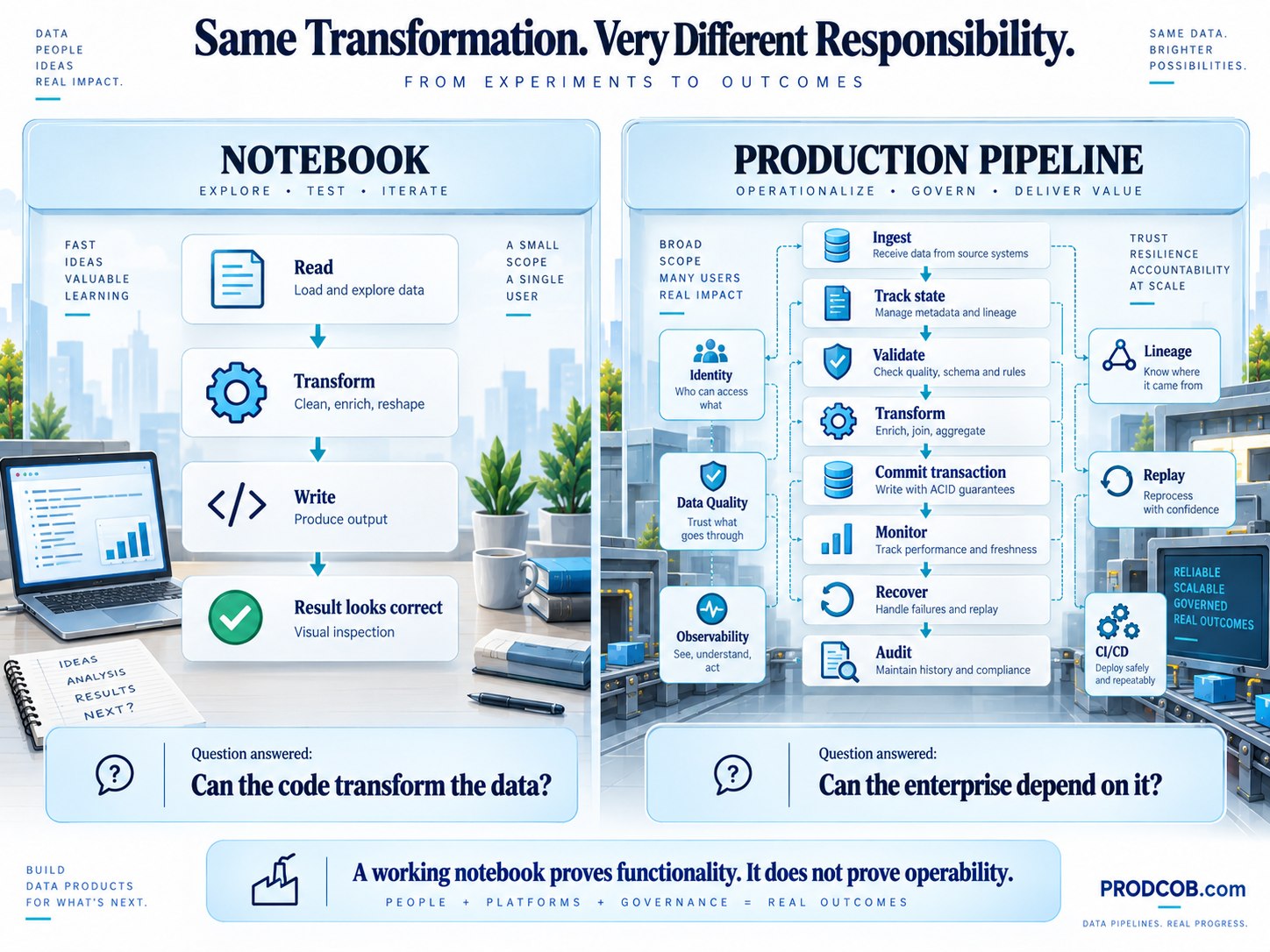
A production pipeline carries obligations that the transformation does not:
- It must know what it already processed.
- It must know what committed successfully.
- It must handle unexpected data.
- It must recover without corrupting the target.
- It must establish which identity is allowed to execute it.
- It must maintain data history where required.
- It must expose lineage.
- It must provide evidence when controls fail.
- It must be deployable repeatedly across development, test and production.
- It must tell someone when it breaks.
The notebook answers: “Can we transform this data?”
The production pipeline answers: “Can the enterprise depend on this data repeatedly, safely and explainably?”
Those are different questions. And in a regulated enterprise, the second question is usually the one that matters.
A Useful Real-World Reference Point
Microsoft published a useful Marks & Spencer example several years ago. M&S described a retail problem in which teams needed to understand where products were across stores multiple times each day and use those observations to forecast demand. The scale of those data points had become difficult for its on-premises environment to handle. Microsoft documented an architecture using Azure Data Lake Storage, Azure Databricks for transformation, Azure Synapse Analytics and Power BI.
I find the scenario useful because the business question is easy to understand:
For every product and every store, how much inventory do we have, how quickly is it moving, and when should we replenish it?
But underneath that simple question sits a difficult data problem. Sales arrive continuously. Returns can reverse prior activity. Inventory snapshots arrive on different schedules. Product classifications change. Stores change. Supplier transactions arrive separately. Corrections may arrive late.
The business does not care that those records originated in six different systems. It wants one trustworthy inventory position. That is where a real pipeline earns its value.
For clarity, I am not suggesting that the current M&S implementation uses every modern Databricks capability discussed below. The Microsoft case is the business reference point. The architecture below is how I would think about that problem using current Azure Databricks capabilities.
The Pipeline Begins Before Bronze
One of the easiest mistakes in lakehouse discussions is to begin the architecture at the Bronze table. The operational problem starts earlier.
Data has to arrive somewhere. For file-based ingestion, that may be an ADLS Gen2 landing location. For streaming events, it might arrive through Azure Event Hubs. Enterprise databases may contribute CDC feeds, extracts or API-delivered data.
The first responsibility is not transformation. It is controlled receipt. A useful landing design preserves enough information to answer basic questions later:
- When did the source create this record?
- When did the platform receive it?
- Which system produced it?
- Which file, partition or event stream did it come from?
- Can we replay it?
- Has the source schema changed?
That sounds mundane compared with machine learning or real-time analytics. But when production data is wrong, those questions suddenly become very expensive.
For cloud files, Azure Databricks Auto Loader provides incremental ingestion through the cloudFiles Structured Streaming source. Microsoft’s current documentation emphasizes incremental processing of arriving files, checkpoint management, schema evolution and production configuration rather than repeatedly rescanning storage as though every file were new.
This is where pipeline state first becomes visible. There are several types of state, and conflating them creates fragile designs.
- The schema state tells us what structure has been observed.
- The streaming checkpoint tells us what processing progress has been completed.
- The Delta transaction log tells us what became a committed table version.
They are related. They are not interchangeable. That distinction becomes critical during recovery.
Bronze Is Evidence, Not Bad Data
Bronze is often described as the “raw layer.” That description is correct but incomplete. I prefer another interpretation:
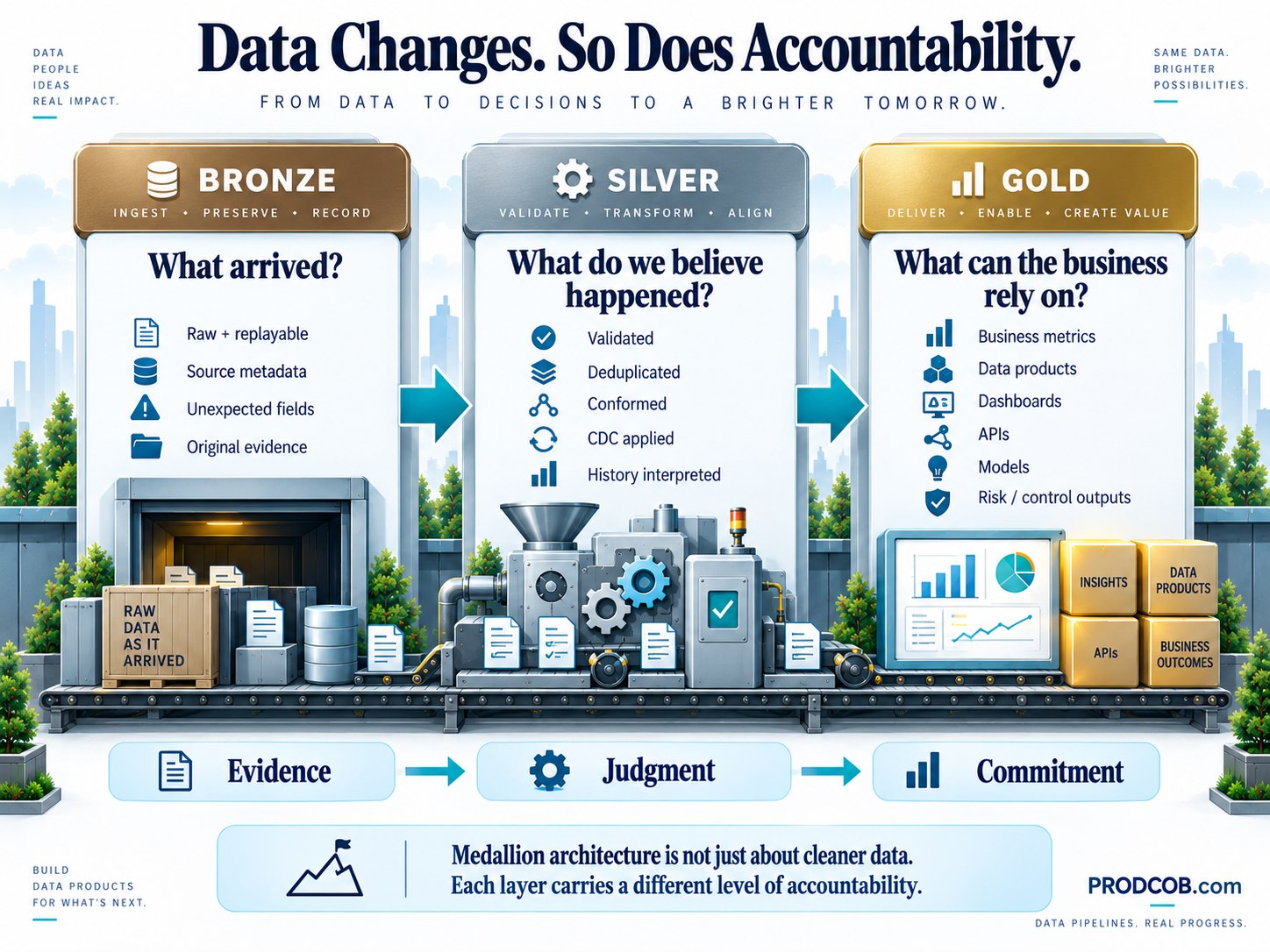
Bronze is the evidence layer. Its value is not that the data is pristine. Its value is that we have preserved what arrived before business interpretation changed it.
That means Bronze is usually the wrong place to become aggressive about correcting the business:
- Capture the source.
- Record ingestion metadata.
- Preserve unexpected fields where practical.
- Retain malformed data where the architecture supports investigation.
- Make the content queryable.
- Do enough technical standardization to operate the platform.
Then resist the urge to turn Bronze into an early version of Silver. Why? Because transformation logic changes. Reference data changes. Business definitions change. Defects are discovered. Regulators ask how a result was produced. Auditors ask what the original source contained.
If Bronze retains the original evidence, downstream layers can often be reconstructed. If Bronze already discarded inconvenient records, “reprocessing” may simply reproduce the same blind spot.
Azure Databricks continues to support the Bronze–Silver–Gold medallion pattern as a way of progressively improving data quality and business usability. But the three colors are not the architecture. They are labels for different responsibilities. That distinction matters.
Silver Is Where the Enterprise Starts Making Judgments
Silver is where the pipeline stops simply recording what arrived and begins deciding what the enterprise believes:
- A transaction is valid.
- A product identifier maps to a mastered product.
- A duplicate should be removed.
- A malformed record belongs in quarantine.
- A source correction supersedes an earlier value.
- A customer attribute must be masked.
- A slowly changing dimension requires historical preservation rather than overwrite.
These are not merely Spark transformations. They are business and control decisions represented as code. That should change how senior leaders think about this layer.
Take a simple retail event sequence:
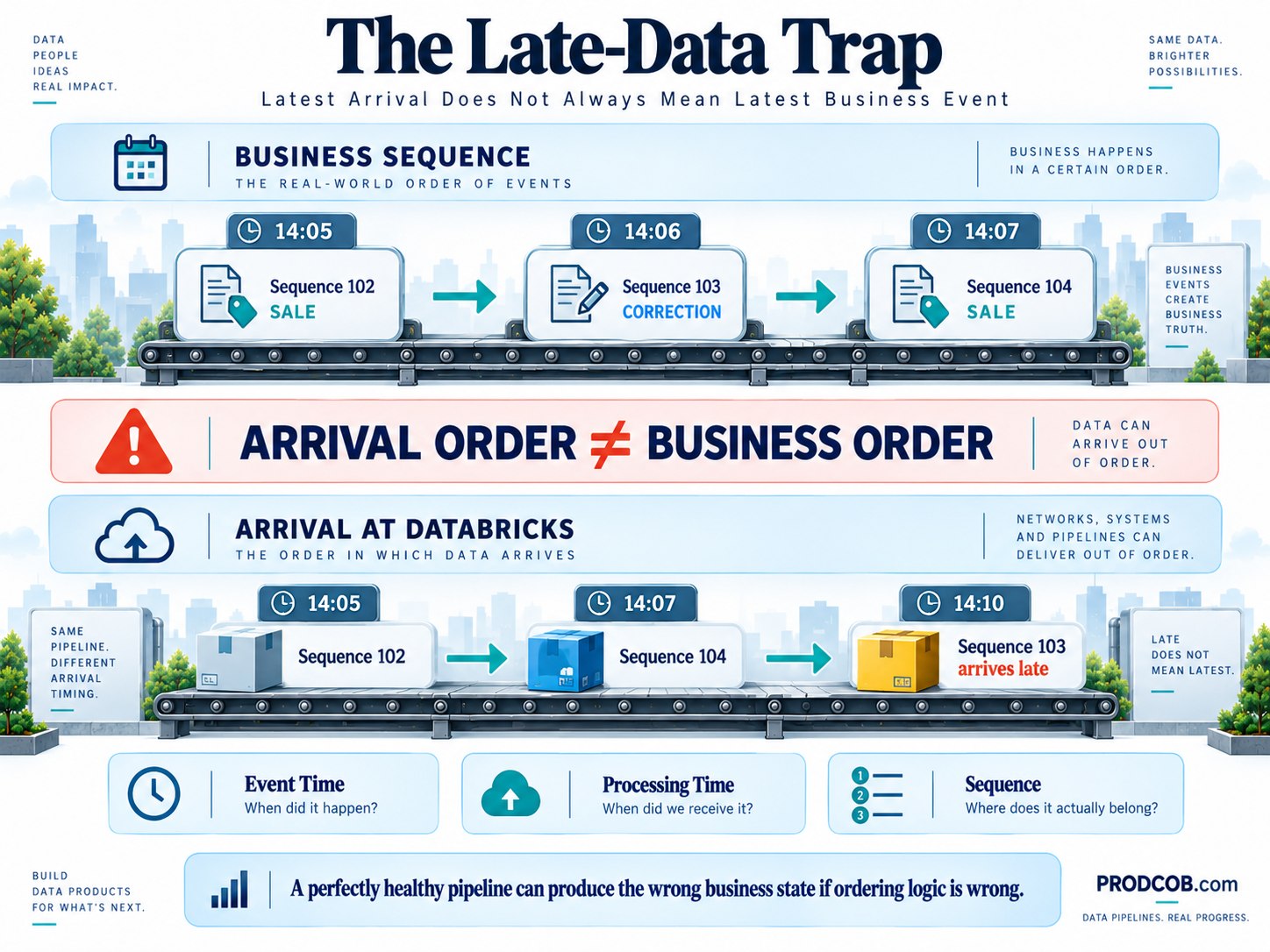
A sale arrives at 14:05. Another transaction arrives at 14:07. At 14:10, a correction arrives that logically belongs between the first two events. Which record is “latest”?
If the pipeline uses arrival time, the correction may incorrectly become the final state. If the source supplies an authoritative transaction sequence, the correct business order may be different.
That leads to concepts data engineers understand well but leaders should also care about:
- Event time — when the business event occurred.
- Processing time — when the platform processed it.
- Sequence — the authoritative ordering provided by the source.
- Watermark — how long the pipeline accepts or reasons about late events.
- State — previously observed information needed to interpret the next event.
The failure mode is subtle. A pipeline can run successfully. No job fails. No alert fires. The dashboard updates. And the business result is still wrong. That is why operational success and data correctness cannot be treated as the same control.
Data Quality Cannot Be a Comment in the Notebook
Another common pattern is to document assumptions rather than enforce them: “Product ID should never be null.” “Quantity should always be positive.” “Every control must have an owner.” “Every account should map to a valid business unit.”
That is documentation. It becomes a control only when the system does something measurable when the assumption fails.
Current Lakeflow pipelines support data-quality expectations that can retain and measure invalid records, drop them, or fail an update depending on the rule and intended behavior. Metrics can also be exposed for monitoring.
The important decision is not whether the technology supports expectations. The leadership decision is:
What kind of failure should this condition represent?
Should the pipeline stop? Should the individual record be quarantined? Should processing continue while the exception rate becomes visible? Those decisions should reflect business materiality. A missing optional description and a missing primary key should not necessarily have identical consequences.
Control design requires proportionality. Overuse “fail everything” and the platform becomes operationally brittle. Ignore everything and poor data quietly becomes trusted data. Neither extreme is governance.
CDC and SCD Are Really About Reconstructing Truth
Change Data Capture and Slowly Changing Dimensions are usually taught as engineering patterns. There is a more consequential way to think about them: they determine whether the enterprise can reconstruct what it believed at a particular point in time.
Suppose a product moved from Department A to Department B on September 1. If the enterprise only cares about the present, overwriting the department may be sufficient. If August reporting must still show the product under Department A, history must be preserved. That is the distinction behind familiar SCD Type 1 and Type 2 patterns.
The technical implementation matters. The control implication matters more.
Current Lakeflow pipeline capabilities include AUTO CDC functionality that can apply change feeds to streaming targets and support SCD Type 1 and Type 2 behavior using keys and sequencing logic. That makes implementation easier. It does not decide what history the business is obligated to retain. Technology should implement the temporal policy. It should not invent it.
Gold Is a Contract With a Consumer
Gold is frequently presented as the “cleanest” layer. I think that undersells it. Gold should exist because somebody is relying on it: a finance team, a risk system, a Power BI dashboard, an executive scorecard, a machine-learning model, an API, a regulatory process, a replenishment engine.
That means Gold should be designed backward from the consumer requirement. For the retail example, useful Gold products might represent store inventory position, daily product sales, sales velocity, days of supply, stockout risk, supplier fill rate, or replenishment recommendations.
The critical difference is intent. Silver might tell us every valid inventory event. Gold tells a consumer:
“This is the inventory position you can use.”
That is effectively a data contract whether the organization formally calls it one or not. Once other systems depend on that output, changes to it become production changes. Column names matter. Definitions matter. Freshness matters. Entitlements matter. Late corrections matter. SLA expectations matter.
The Gold layer is therefore not where engineering ends. It is where accountability becomes visible.
Delta Lake Is the Ledger Behind the Factory
One of the reasons the lakehouse architecture became important is that ordinary object storage does not naturally behave like a transactional database. Writing files is easy. Determining which set of files represents a valid committed table state is harder. Delta Lake provides that transactional layer.
Microsoft describes Delta Lake as the storage foundation for Databricks tables, providing capabilities including ACID transactions, schema enforcement, version history and time travel.
This is where my factory analogy becomes particularly useful. Parquet files contain the goods. The Delta transaction log is the ledger.
Imagine a distributed job intends to create ten output files. Seven are written. Then compute fails. Without transactional semantics, downstream consumers could potentially encounter an incomplete result depending on the implementation. With a transactionally managed table, the new table version becomes meaningful only when the transaction successfully commits.
That is not an obscure data-engineering detail. It is what separates “some files were written” from “the enterprise now has a new valid version of the dataset.”
Spark Is the Machinery — and Machinery Can Be Poorly Designed
A correct transformation can still be a bad production workload. This is another point that tends to get lost during functional testing.
Spark converts logical DataFrame or SQL operations into distributed execution plans. Joins become broadcast operations or shuffles. Aggregations create stages. Partitions move across workers. Intermediate data may spill to disk. Skew can cause one executor to process disproportionately large partitions. Small-file patterns can slowly degrade performance. A query can be logically elegant and operationally expensive.
That means architecture reviews should not stop at “does the SQL produce the correct answer?” They should also ask:
- How much data moves? How frequently?
- What is recomputed? What is incremental?
- Where are the large shuffles?
- What happens under peak volume?
- How much state is retained?
- What happens when one key represents 30 percent of the data?
- What does failure recovery cost?
Performance is not simply a tuning issue. At scale, inefficient processing becomes an availability and cost issue. That turns architecture into economics.
A Pipeline and a Workflow Are Not the Same Thing
The naming can create confusion. Current Azure Databricks documentation describes Lakeflow pipelines as the declarative mechanism for building batch and streaming data pipelines. Lakeflow pipelines extend Apache Spark Declarative Pipelines and manage concepts such as streaming tables, materialized views and flows.
Lakeflow Jobs addresses a different operating problem. A workflow may need to run ingestion, validate reconciliation, refresh downstream products, execute a forecast, publish results, and notify operations. Some tasks run sequentially. Others run in parallel. Some retry. Some execute only after another task succeeds or fails. Lakeflow Jobs supports dependencies, retries and conditional control flow across tasks.
This is an important architectural boundary. The pipeline describes how datasets are produced. The workflow coordinates how production activities execute. Trying to force every operational dependency into transformation code usually creates systems that are harder to understand, harder to recover and harder to control.
Unity Catalog Is Not the Team That Moves the Boxes
Unity Catalog is sometimes inserted into architecture diagrams as though it were another data-processing stage. It is not. It is the governance plane.
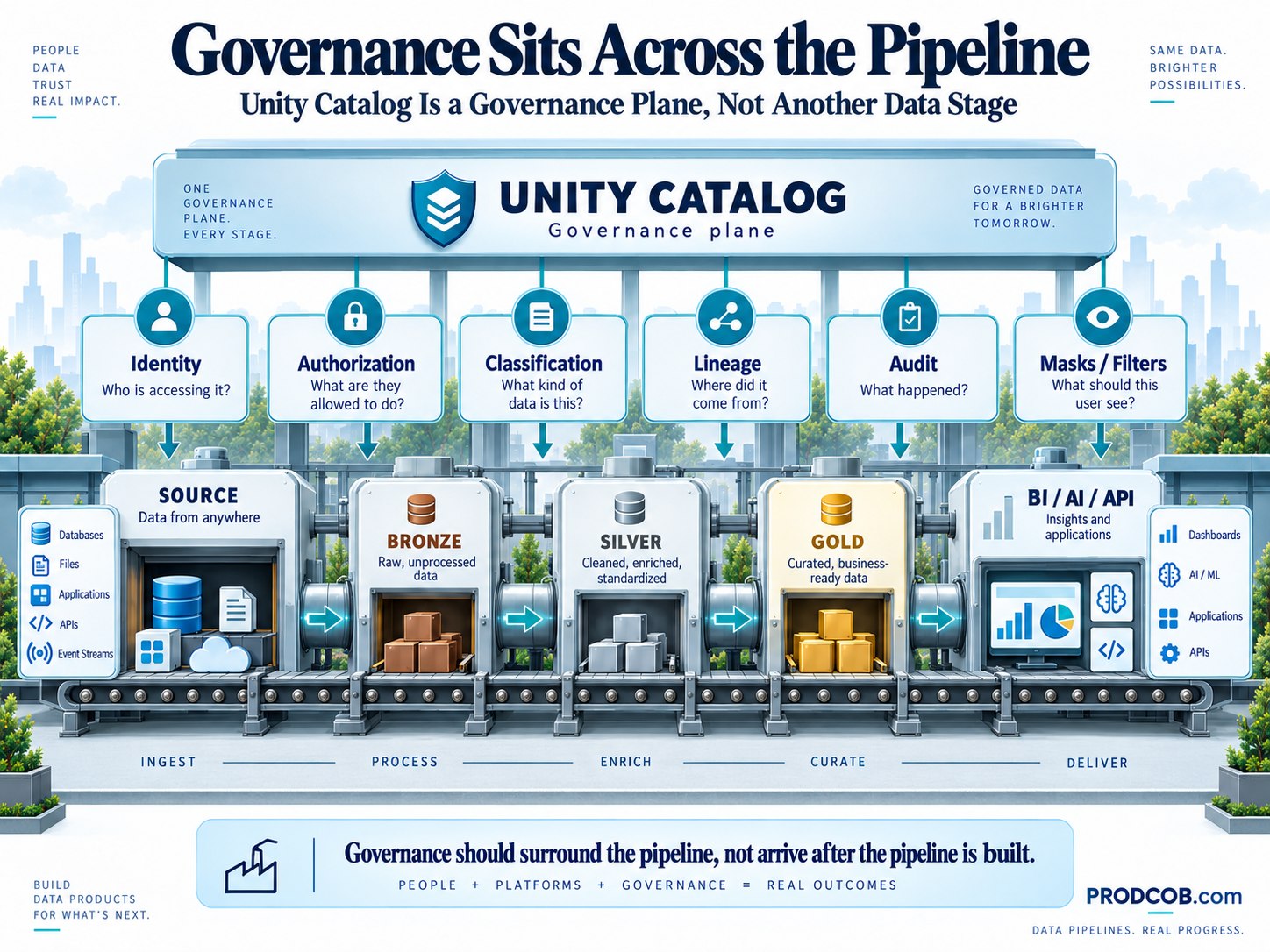
Current Microsoft documentation describes Unity Catalog as the unified governance layer across Azure Databricks, covering areas including access control, discovery, lineage, auditing, classification and governance of data and AI assets.
That distinction matters because governance should not depend on remembering to bolt permissions onto each notebook. A production workload should operate through controlled identities and governed objects.
- An engineer’s personal credential is not a production identity strategy.
- A storage key pasted into code is not secrets management.
- A table nobody can trace back to its inputs is not governed merely because it sits in the “Gold” schema.
This is where mature organizations begin separating convenience from control. The convenient development path is often personal access. The durable production path requires workload identities, least privilege, controlled storage access, lineage and auditable activity. Those controls can feel slower during development. They become much cheaper during an incident.
The Real Test Is Failure
The quality of a pipeline becomes most visible when something goes wrong. Consider a streaming Silver update processing hundreds of newly discovered files. The input has been identified. Spark processes the records. Candidate output is produced. The transaction is preparing to commit. Then the driver fails.
What should happen?
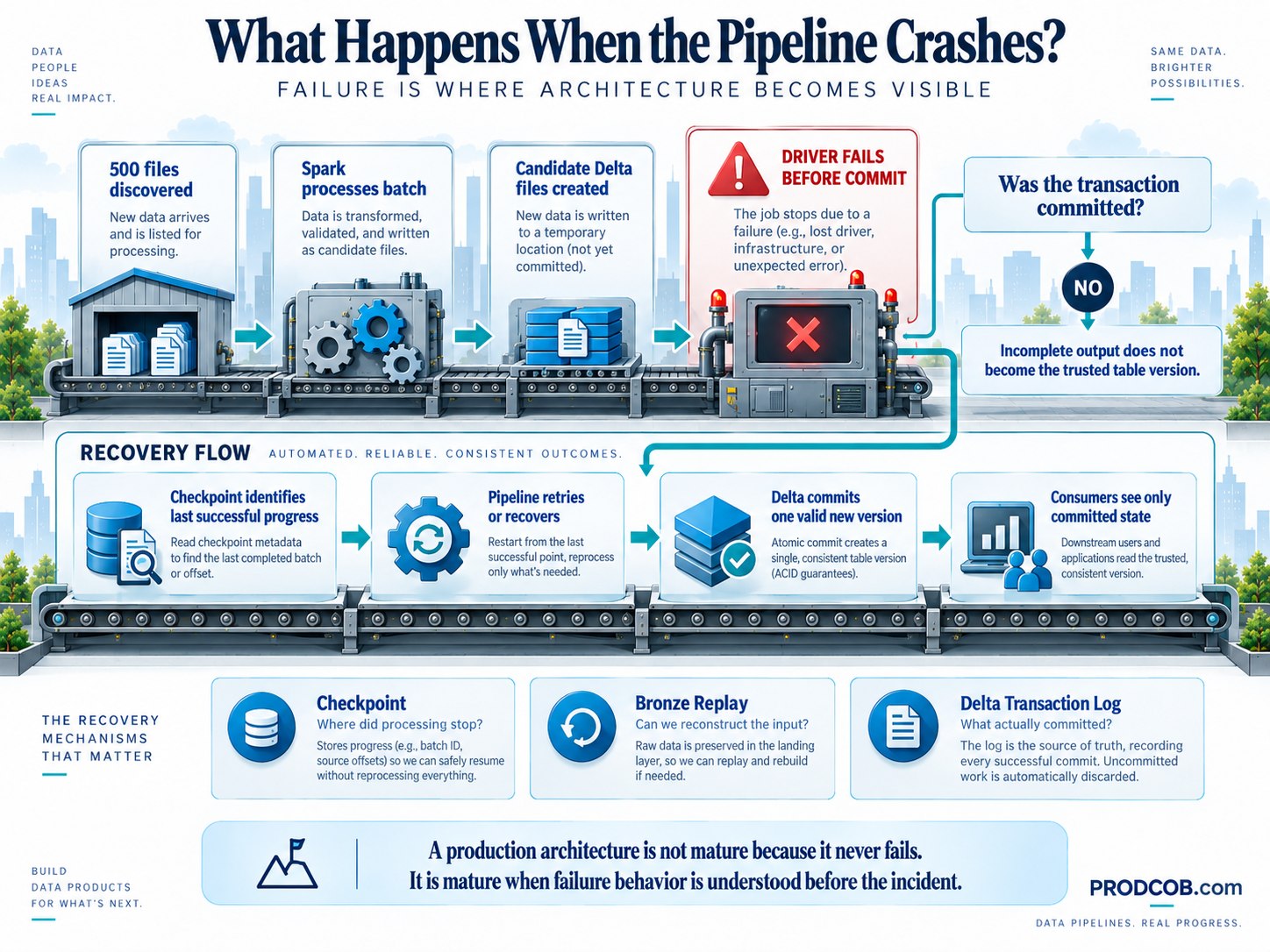
The answer cannot be “we rerun the notebook and hope it picks up correctly.”
The system should know the last successfully completed processing state. Incomplete work should not become a valid downstream table version. The pipeline should be able to resume or replay according to a known recovery pattern. And the support team should know what evidence tells them whether they are recovering safely.
That is why checkpoints, transactional commits, durable Bronze data and idempotent design are not implementation trivia. They are recovery controls.
Then ask the harder questions:
- What if the source sent the event twice?
- What if the record arrived three days late?
- What if the schema changed?
- What if credentials expired?
- What if downstream Gold refreshed but the forecast job failed?
- What if the quality rule failed on only one branch?
- What if a supposedly replayable source has already purged the original record?
A production architecture is not mature because nothing has failed. It is mature when failure behavior is understood before the incident.
Production Readiness Is Primarily a Control Question
Microsoft’s current production-readiness guidance for Lakeflow pipelines is revealing. It emphasizes data-quality expectations, intentional triggered-versus-continuous execution choices, scheduled execution, failure notifications, checkpoint recovery procedures and running workloads with service principals rather than personal identities.
That is notable because relatively little of that list is about writing transformation logic. It is about operating the system.
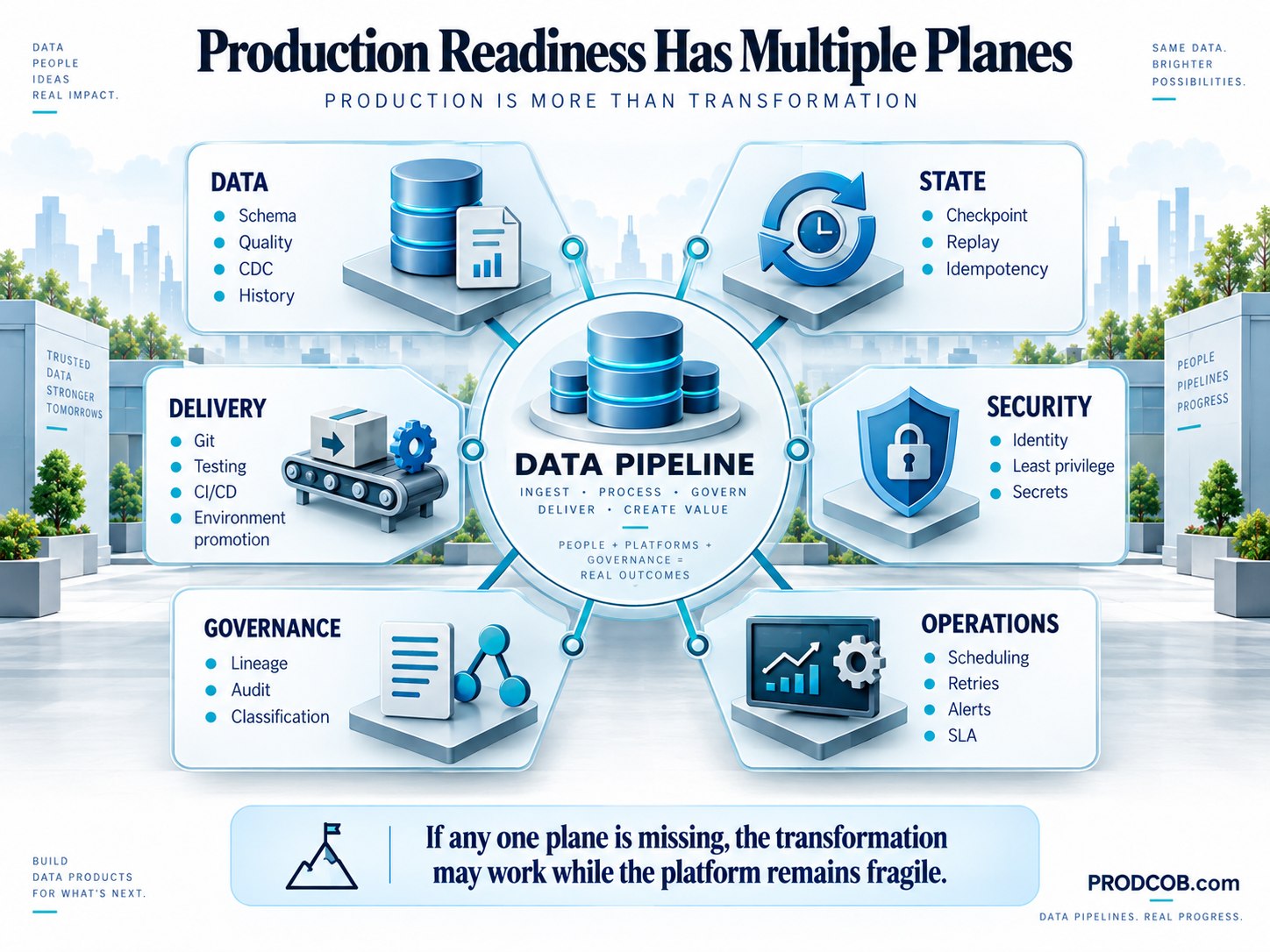
The same applies to deployment. Current Databricks guidance positions Declarative Automation Bundles — formerly Databricks Asset Bundles — as a mechanism for bringing source control, code review, testing and CI/CD practices to Databricks resources including jobs and pipelines.
This is where a data platform starts looking less like an analytics workspace and more like enterprise software. That is a healthy development. Data platforms increasingly power operational decisions, customer experiences, risk calculations, controls, AI models and regulatory processes. We should expect their engineering discipline to reflect that importance.
The Question Leaders Should Ask Is Not “Do We Use Databricks?”
Technology selection is rarely the hardest question. The harder questions are operational. When a team presents a Databricks pipeline, I would want to understand:
- What constitutes the authoritative source event?
- What is preserved before transformation?
- What processing state is durable?
- Can we replay safely?
- How are duplicates recognized?
- How are late events ordered?
- Where is history intentionally preserved or overwritten?
- Which data-quality conditions warn, quarantine or stop processing?
- Who owns the business rule behind each material condition?
- What identity executes production workloads?
- Who can access the resulting tables?
- Can lineage connect the business output to the underlying source?
- What happens if the final commit fails?
- What happens if only one downstream branch fails?
- How does the team know a run is incomplete?
- How is production configuration deployed?
- Can the same artifact move through development, testing and production with controlled differences?
And perhaps the most uncomfortable question:
Which parts of this design still rely on a knowledgeable person remembering what to do?
That is usually where operational risk is hiding.
The Executive Takeaway
Databricks can make sophisticated data engineering materially easier. That should not encourage us to lower the bar for production engineering. It should allow us to raise it.
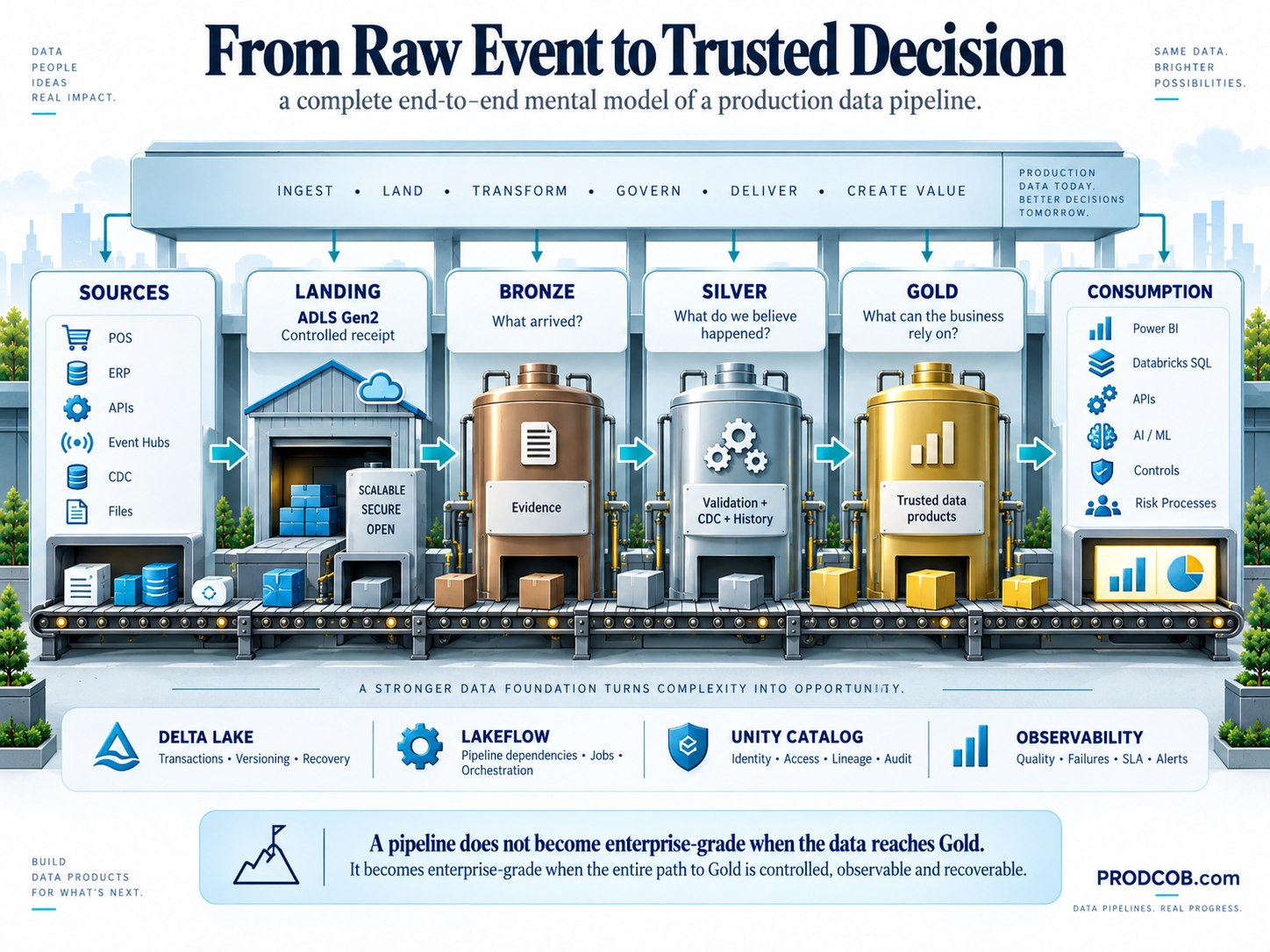
The dangerous assumption is that because ingestion, streaming, Delta tables, declarative pipelines, orchestration and governance are increasingly integrated into one platform, the resulting system automatically becomes reliable. It does not. Capabilities reduce implementation friction. They do not eliminate architecture decisions.
The pipeline still needs an explicit view of state, ordering, quality, identity, recovery, history, ownership and accountability. That is why I return to the factory model:
- ADLS stores the goods.
- Spark runs the machinery.
- Delta keeps the ledger.
- Lakeflow operates the production line.
- Unity Catalog controls access and records governance context.
A factory does not become dependable simply because all the machinery has been installed. It becomes dependable when leadership knows what happens when the machinery does not behave as expected. That is the difference between a data pipeline that runs and a data pipeline the enterprise can rely on.
This article reflects my personal analysis and interpretation of publicly available product documentation and architectural patterns for educational and professional discussion purposes. It does not represent the views of my employer or any other organization. Product capabilities, terminology and service availability may change over time. Organizations should validate current vendor documentation and evaluate security, regulatory, architectural and operational requirements within their own environments before implementation.
Suggested External References
- Microsoft — Marks & Spencer Azure customer story. Real-world reference for the retail inventory and demand problem, including ADLS, Azure Databricks and Azure Synapse. Marks & Spencer speeds up insights with Azure
- Microsoft Learn — Spark Declarative Pipelines / Lakeflow. Current Azure Databricks documentation for declarative pipeline architecture. Spark Declarative Pipelines
- Microsoft Learn — Auto Loader. Reference for incremental cloud-file ingestion and
cloudFiles. Azure Databricks Auto Loader - Microsoft Learn — Unity Catalog. Current governance model covering access control, lineage, auditing and data/AI assets. What is Unity Catalog?
- Microsoft Learn — Pipeline Expectations. Reference for warn, drop and fail behavior in pipeline data-quality controls. Manage data quality with pipeline expectations
- Microsoft Learn — Declarative Automation Bundles. Current deployment and CI/CD approach; formerly Databricks Asset Bundles. Declarative Automation Bundles