
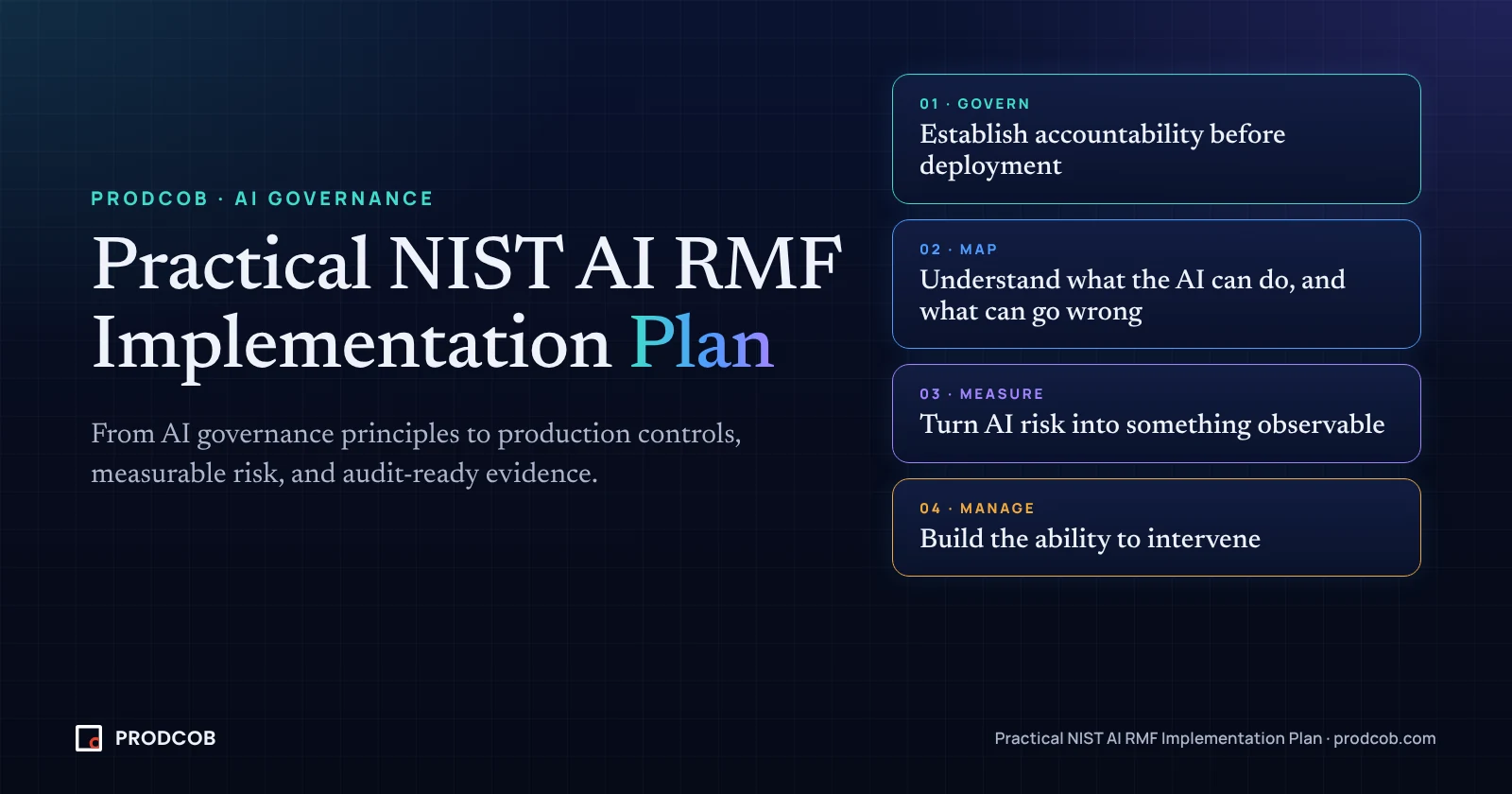
From AI governance principles to production controls, measurable risk, and audit-ready evidence.
AI Governance Is Not the Hard Part. Operationalizing It Is.
An enterprise launches an AI assistant to accelerate execution testing. The application reviews supporting documents, identifies potential gaps, and prepares draft packages for analysts.
The pilot is successful. Analysts spend less time reviewing documents, management sees an opportunity to improve productivity, and the technology team begins planning broader deployment.
Then a risk executive asks a simple question:
“How do we know the AI is making reliable decisions, and what happens when it gets something wrong?”
The project team points to its governance policy, model documentation, and security assessment.
Those are necessary. But they do not fully answer the question.
Can the organization identify every AI agent operating in the environment? Does it know which documents each agent can access? Can it distinguish an incorrect AI conclusion from a missing source document? Who has the authority to stop the system when its behavior changes?
These are implementation questions, not policy questions.
This is where the NIST AI Risk Management Framework (AI RMF) becomes useful.
The framework provides a structured way to think about AI risk through four functions: Govern, Map, Measure, and Manage.
But there is an important distinction. NIST does not prescribe a mandatory deployment sequence. Its AI RMF and accompanying Playbook are voluntary resources intended to be adapted to organizational needs.
The challenge for technology leadership is translating these principles into operating controls.
For that, I favor one simple mental model:
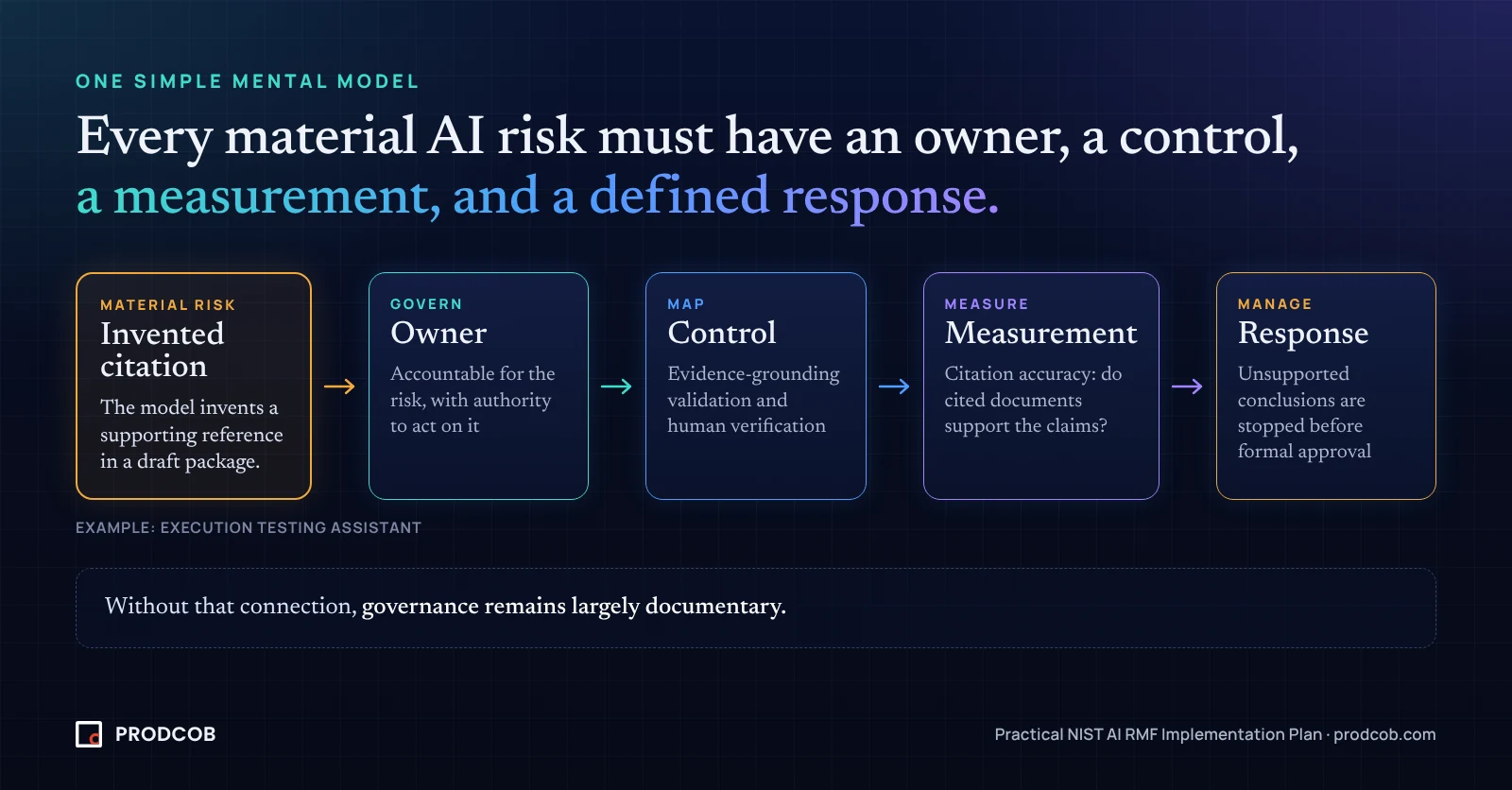
Every material AI risk must have an owner, a control, a measurement, and a defined response.
Without that connection, governance remains largely documentary.
Start With One Business Scenario, Not an Enterprise-Wide Governance Program
Consider an institution implementing an AI-powered Execution Testing Assistant.
Its responsibility is straightforward:
- Retrieve authorized execution-testing evidence.
- Interpret relevant policies and procedures.
- Identify gaps in the available documentation.
- Prepare a draft testing package.
- Present findings for human review and approval.
The intended benefit is faster, more consistent preparation of packages.
The risks are equally tangible.
The model might invent a supporting reference. It might interpret a policy incorrectly. The retrieval service could expose documents belonging to another business unit. An agent might execute a tool action beyond its authority.
Now imagine this application expanding from a handful of analysts to hundreds of users, with multiple AI models, agents, tools, and data sources.
The central risk is no longer whether the underlying model performs well in a demonstration.
It is whether the institution can maintain control as the operating environment becomes more complex.
A practical implementation of NIST AI RMF should begin with this distinction.
1. GOVERN: Establish Accountability Before Deployment
The leadership question: Who is accountable for what the AI does?
The first implementation decision is not which monitoring tool to purchase. It is establishing who owns the AI application and its risks.
An AI system should have a documented identity within the organization’s technology inventory.
For our Execution Testing Assistant, that record might contain:
| Inventory attribute | Example |
|---|---|
| AI application | Execution Testing Assistant |
| Business purpose | Draft Execution Testing Package |
| Product owner | Engineering and Technology |
| Model | Approved enterprise LLM |
| Data sources | Authorized evidence repositories |
| Capabilities | Retrieval, summarization, draft preparation |
| Decision authority | Designated human reviewer |
| Risk classification | Determined through institutional assessment |
This inventory should extend beyond the application name.
In agentic environments, the institution also needs visibility into agents, service identities, model versions, tool connections, and system dependencies.
Otherwise, the application may be registered while the activities it performs remain inadequately controlled.
Define ownership without diluting accountability
A practical ownership model separates responsibilities:
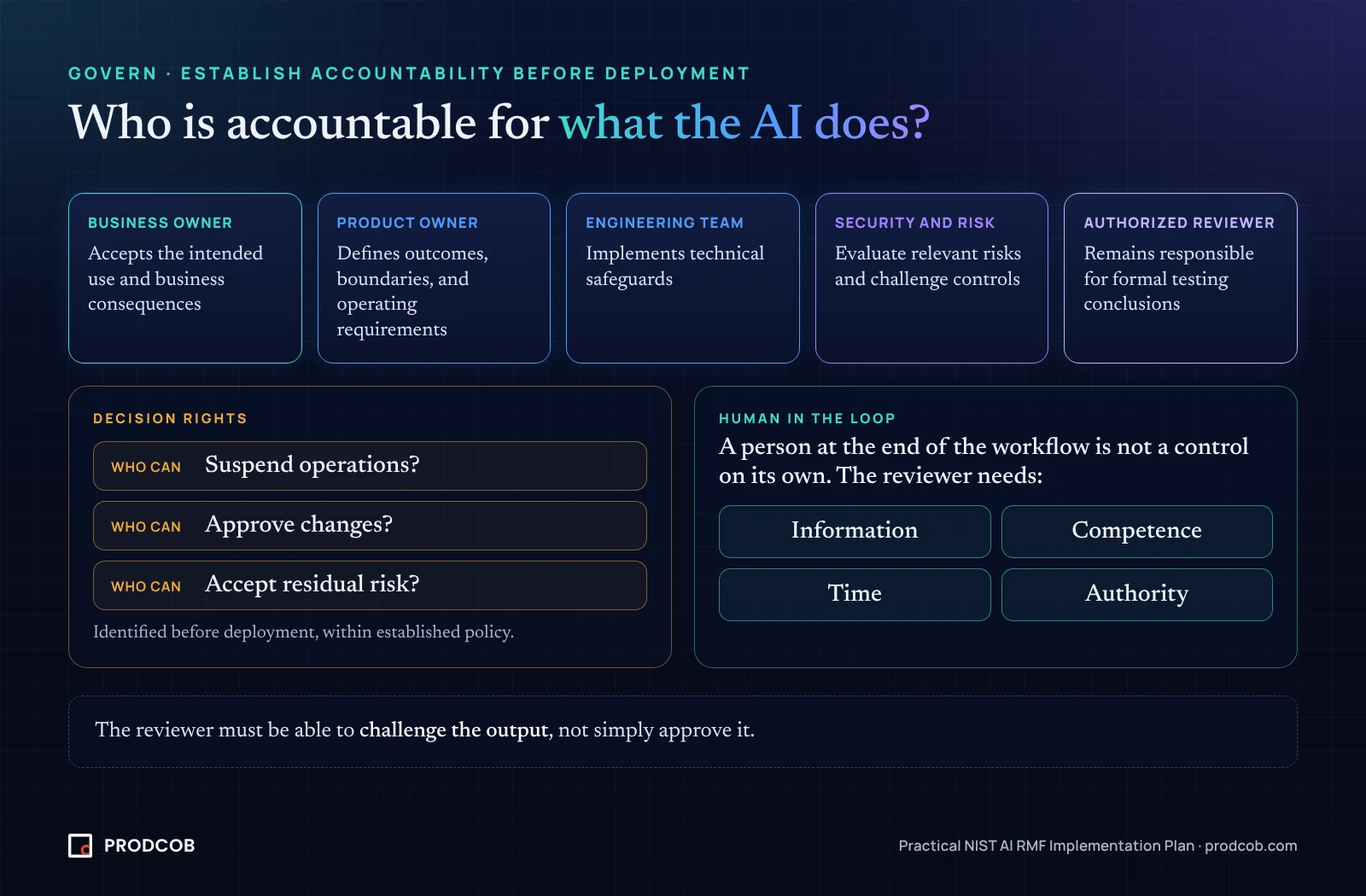
- The business owner accepts the intended use and business consequences.
- The product owner defines outcomes, boundaries, and operating requirements.
- The engineering team implements technical safeguards.
- The security and risk functions evaluate relevant risks and challenge controls.
- The authorized reviewer remains responsible for formal testing conclusions.
The organization should also identify who can suspend operations, approve changes, or accept residual risk within established policy.
Human-in-the-loop is not an adequate control simply because a person appears at the end of the workflow.
That person must have the information, competence, time, and authority to challenge the output.
Practical output: AI inventory, ownership matrix, approved-use definition, risk classification, and documented decision rights.
Relevant NIST outcomes: GOVERN 1.3, 1.6, 2.1, 2.3, and 3.2.
2. MAP: Understand What the AI Can Do, and What Can Go Wrong
The leadership question: Can we explain the complete path from business request to AI-generated decision?
Many enterprise AI architectures explain the model but provide little visibility into its surrounding dependencies.
Consider the workflow:
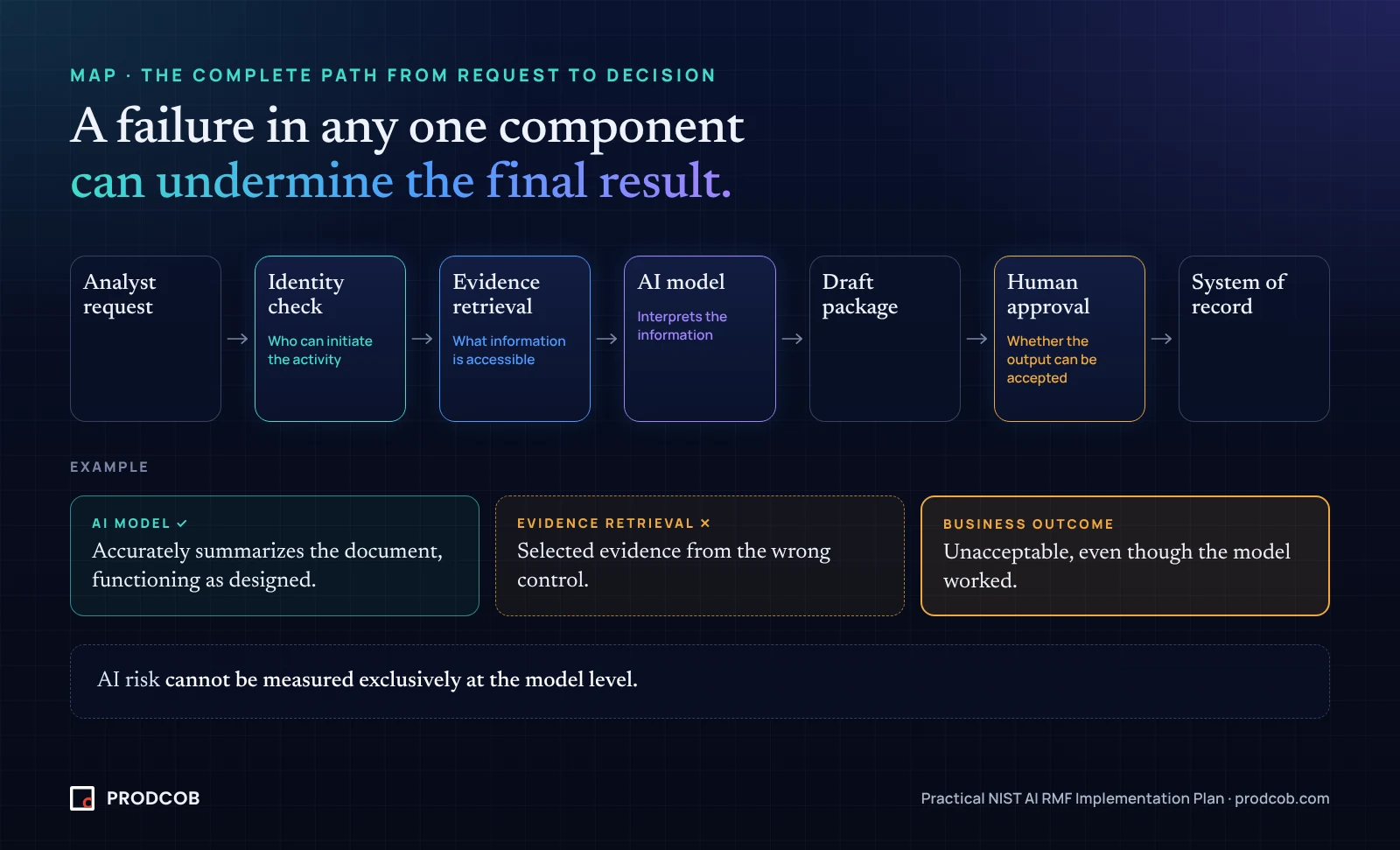
Analyst Request → Identity Check → Evidence Retrieval → AI Model → Draft Package → Human Approval → System of Record
Each component introduces different risks.
The identity layer determines who can initiate the activity. The retrieval layer determines what information is accessible. The model interprets the information. The human reviewer determines whether the output can be accepted.
A failure in any one of these components can undermine the final result.
For example, suppose the model accurately summarizes a document, but the retrieval service selected evidence from the wrong control.
The model may be functioning as designed while the application produces an unacceptable business outcome.
This is why AI risk cannot be measured exclusively at the model level.
Map risks to operational controls
| Risk scenario | Required control |
|---|---|
| AI invents a supporting citation | Evidence-grounding validation and human verification |
| Agent accesses restricted information | Identity-based authorization enforced at retrieval and tool boundaries |
| AI misinterprets testing criteria | Domain-specific evaluation and reviewer challenge |
| Untrusted document contains malicious instructions | Prompt-injection defenses and restricted tool privileges |
| Model or prompt changes unexpectedly affect results | Version control, regression testing, and release approval |
The risk assessment should distinguish the likelihood of an event from its potential consequences.
Not every model error warrants the same response.
An incorrect summary in an internal draft may be recoverable. An unsupported control conclusion incorporated into formal regulatory reporting could carry significantly greater consequences.
Practical output: Architecture and data-flow map, agent and tool inventory, risk register, control mapping, and documented risk tolerances.
Relevant NIST outcomes: MAP 1, MAP 4, MAP 5, and GOVERN 1.3.
3. MEASURE: Turn AI Risk Into Something Observable
The leadership question: What evidence tells us that our controls are working?
This is often where AI governance programs struggle.
Organizations track token consumption, response time, and model utilization because these metrics are relatively easy to collect.
They are useful operating metrics. They are not sufficient evidence of trustworthy AI.
For the Execution Testing Assistant, leadership needs to know whether the system produces reliable, appropriately supported packages.
That requires measurements connected directly to identified failure scenarios.
| Measurement | What it establishes |
|---|---|
| Evidence-grounding rate | Whether generated claims are supported by retrieved evidence |
| Citation accuracy | Whether cited documents support the claims being made |
| Critical error rate | How frequently material conclusions are incorrect |
| Unauthorized access attempts | Whether prohibited access is being attempted |
| Authorization enforcement | Whether tested unauthorized actions are consistently blocked |
| Human override rate | How frequently reviewers correct or reject AI output |
| Production quality trend | Whether performance is degrading from the validated baseline |
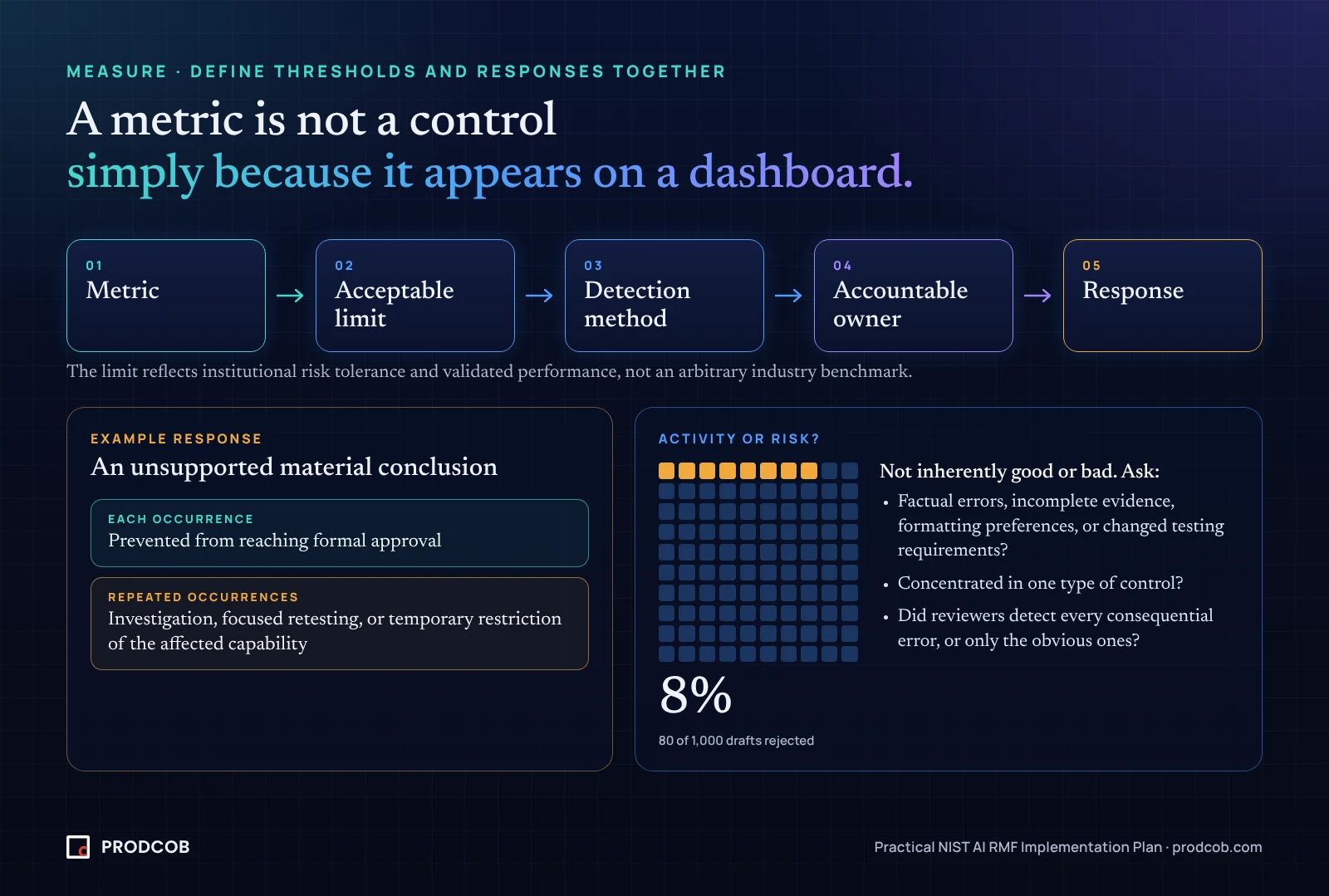
One distinction matters: a metric is not a control simply because it appears on a dashboard.
Consider an AI system that generates 1,000 package drafts.
Suppose reviewers reject 80.
An 8% rejection rate is not inherently good or bad.
Were those rejections caused by factual errors, incomplete evidence, formatting preferences, or changes in testing requirements?
Were the errors concentrated in one type of control?
Did reviewers detect every consequential error, or only the obvious ones?
Without understanding these distinctions, the organization may be measuring activity rather than risk.
Define thresholds and responses together
For each critical measurement, define:
Metric → Acceptable Limit → Detection Method → Accountable Owner → Response
For example, an unsupported material conclusion should be prevented from reaching formal approval. Repeated occurrences should trigger investigation, focused retesting, or temporary restriction of the affected capability.
The actual threshold must reflect institutional risk tolerance and validated performance, rather than an arbitrary industry benchmark.
The same principle applies to drift, unauthorized tool use, data leakage, or security failures.
Independent testing should challenge normal scenarios, unusual inputs, missing evidence, adversarial prompts, and changes in operational conditions.
Practical output: Evaluation dataset, measurement definitions, approved thresholds, independent test results, and monitoring requirements.
Relevant NIST outcomes: MEASURE 1.1, 1.2, 1.3, 2.4, 2.5, and 2.7.
4. MANAGE: Build the Ability to Intervene
The leadership question: When AI becomes unreliable, can we contain the impact before it spreads?
Monitoring identifies a problem. Risk management determines what happens next.
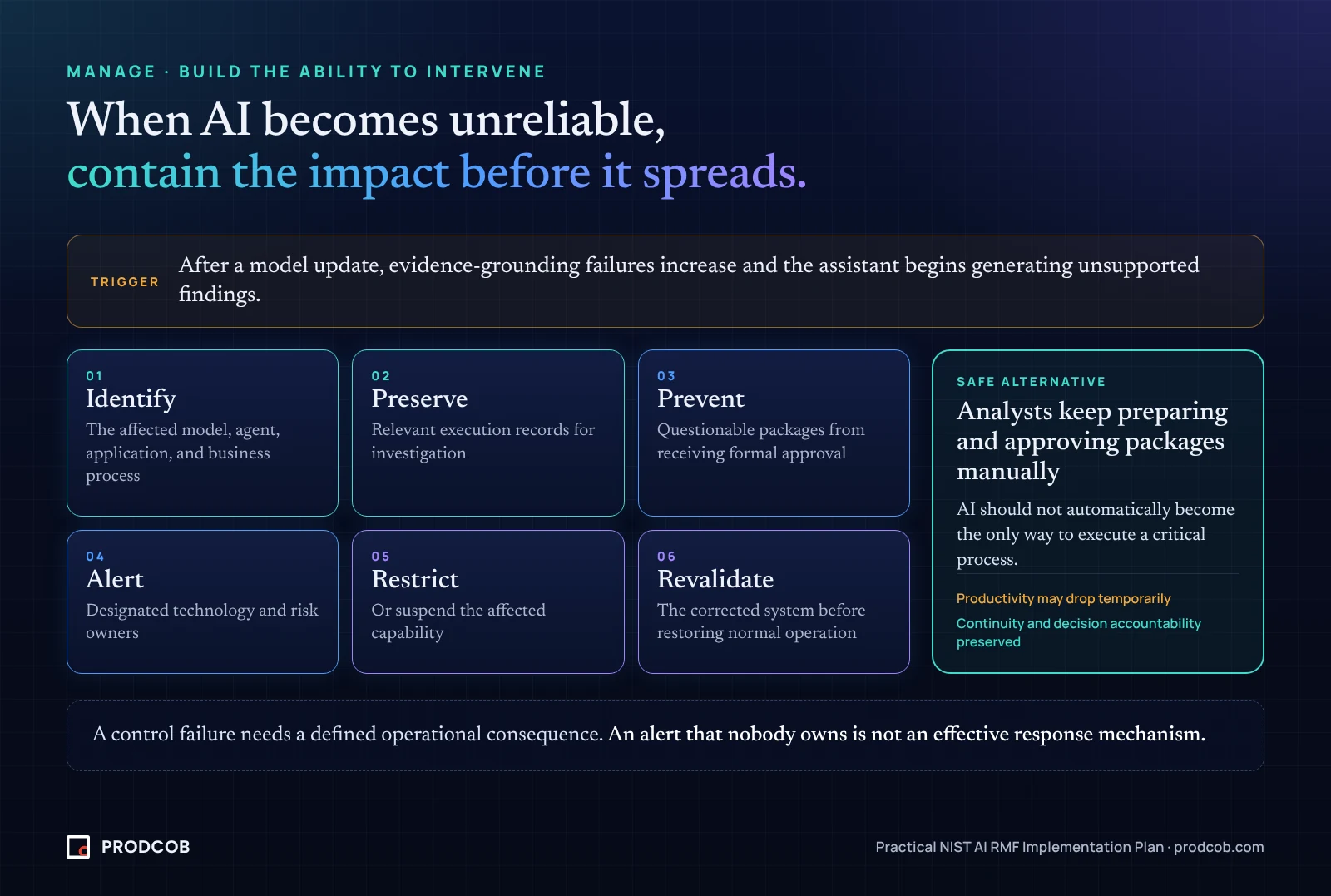
Imagine that the Execution Testing Assistant begins generating unsupported findings following a model update.
The observability platform detects an increase in evidence-grounding failures.
What happens?
A mature operating model should be capable of:
- Identifying the affected model, agent, application, and business process.
- Preserving relevant execution records for investigation.
- Preventing questionable packages from receiving formal approval.
- Alerting designated technology and risk owners.
- Restricting or suspending the affected capability.
- Revalidating the corrected system before restoring normal operation.
The important design consideration is that a control failure should have a defined operational consequence.
An alert that nobody owns is not an effective response mechanism.
Neither is a weekly dashboard that identifies a serious problem after the affected outputs have already been consumed.
Keep a safe alternative available
In regulated environments, AI should not automatically become the only way to execute a critical process.
For our example, analysts should be able to continue preparing and approving packages manually if the AI capability must be disabled.
That may reduce productivity temporarily, but it preserves business continuity and decision accountability.
The institution must consciously decide which capabilities can continue during degraded operation and which require immediate suspension.
Practical output: Incident response procedures, escalation paths, containment controls, rollback capability, change management, and business continuity arrangements.
Relevant NIST outcomes: MANAGE 2.1, 2.4, 3.1, 4.1, 4.2, and 4.3.
Where Observability Connects the Four Functions
The four functions should not become four disconnected governance initiatives.
The connection is the evidence produced as the AI system operates.
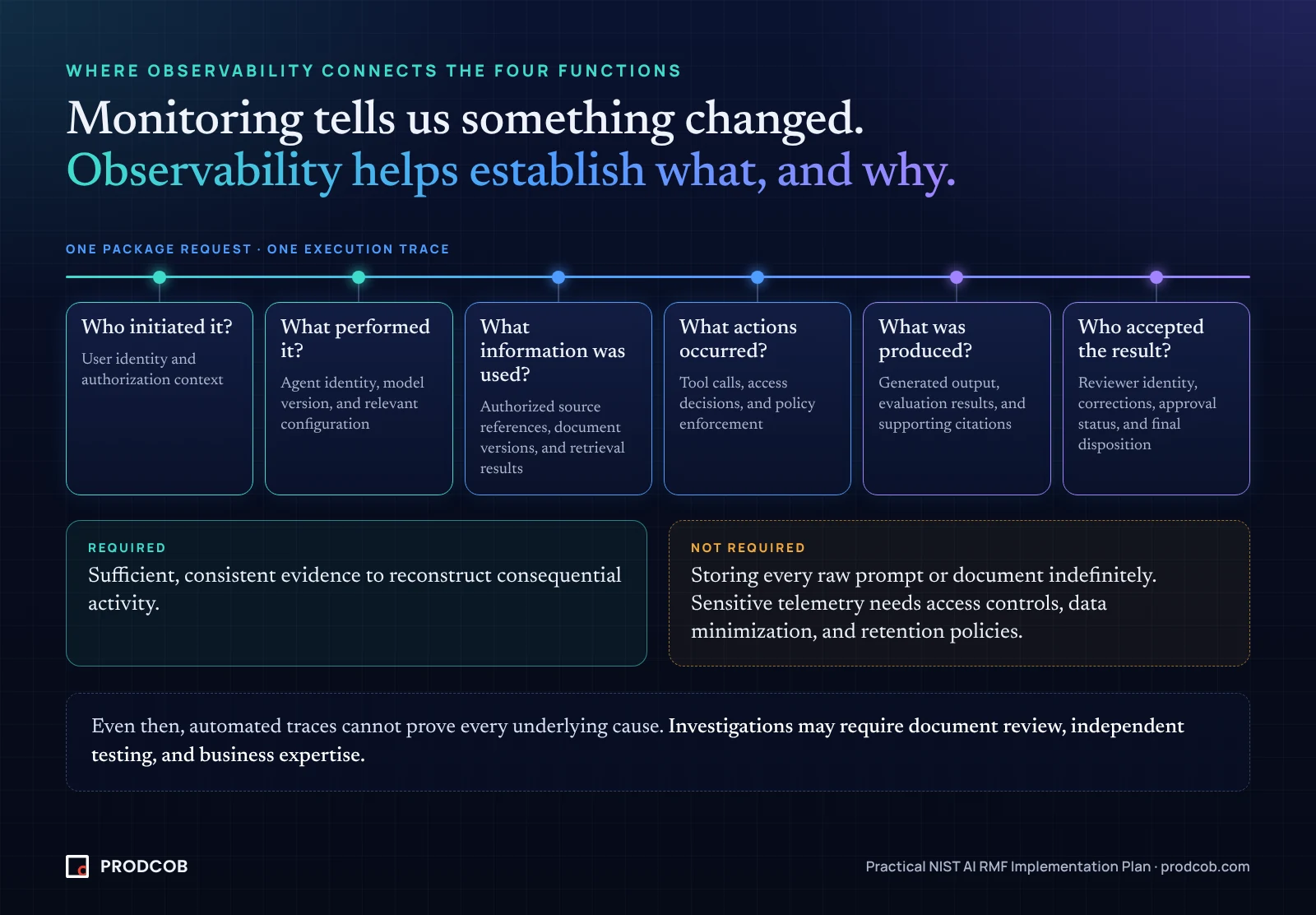
Consider a single package-generation request.
The system should be able to associate that request with:
Who initiated it? User identity and authorization context.
What performed it? Agent identity, model version, and relevant configuration.
What information was used? Authorized source references, document versions, and retrieval results.
What actions occurred? Tool calls, access decisions, and policy enforcement.
What was produced? Generated output, evaluation results, and supporting citations.
Who accepted the result? Reviewer identity, corrections, approval status, and final disposition.
A common execution trace linking these events can make investigation and audit reconstruction materially easier.
This does not require storing every raw prompt or document indefinitely. Sensitive telemetry introduces its own security and privacy risks, which require access controls, data minimization, and appropriate retention policies.
But it does require sufficient, consistent evidence to reconstruct consequential activity.
The difference between basic AI monitoring and effective AI observability is therefore significant.
Monitoring tells us that something changed. Observability helps establish what changed, why it matters, and which component or decision contributed to the outcome.
Even then, automated traces cannot prove every underlying cause. Investigations may require document review, independent testing, and business expertise.
A Practical 90-Day Implementation Plan
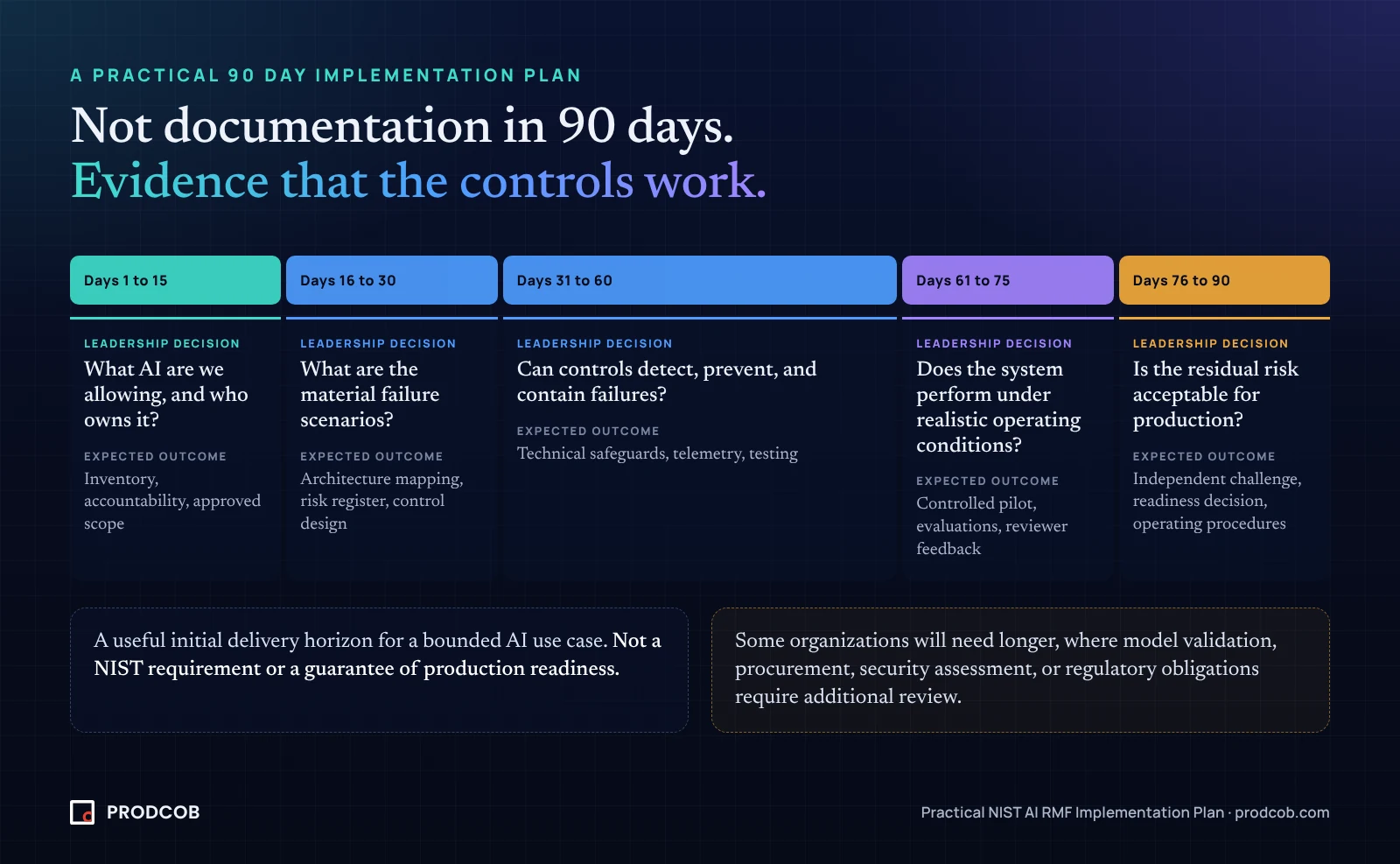
A 90-day plan is a useful initial delivery horizon for a bounded AI use case, not a NIST requirement or a guarantee of production readiness.
| Period | Leadership decision | Expected outcome |
|---|---|---|
| Days 1–15 | What AI are we allowing, and who owns it? | Inventory, accountability, approved scope |
| Days 16–30 | What are the material failure scenarios? | Architecture mapping, risk register, control design |
| Days 31–60 | Can controls detect, prevent, and contain failures? | Technical safeguards, telemetry, testing |
| Days 61–75 | Does the system perform under realistic operating conditions? | Controlled pilot, evaluations, reviewer feedback |
| Days 76–90 | Is the residual risk acceptable for production? | Independent challenge, readiness decision, operating procedures |
Some organizations will need longer, particularly where model validation, procurement, security assessment, or regulatory obligations require additional review.
The objective is not to compress governance into 90 days.
It is to avoid spending 90 days producing documentation without demonstrating that the intended controls work.
What Should an AI Audit Actually See?
An auditor should not have to reconstruct the system’s behavior from disconnected presentations and spreadsheets.
For a selected AI-generated package, the institution should be able to retrieve evidence showing:
- The application and model were authorized for the stated use.
- Relevant users and agents operated within approved permissions.
- The source evidence and system configuration were traceable.
- Appropriate evaluation and safeguards were applied.
- A qualified reviewer made the required decision.
- Any identified exceptions were investigated and resolved or formally managed.
These records help demonstrate control design and operation. They do not, by themselves, establish legal compliance or guarantee the correctness of every AI-generated result.
The applicable requirements must still be determined based on the institution, jurisdiction, business purpose, and consequences of use.
For a U.S. financial institution, NIST AI RMF should complement, not replace, applicable model risk management, information security, privacy, operational risk, records management, and third-party risk requirements.
The Executive Decision: Are We Governing the Model or the Business Outcome?
There is a tendency to treat AI governance as an extension of model management.
That perspective becomes increasingly inadequate when AI applications combine models, retrieval systems, external services, agents, and automated tools.
A model may be reliable in isolation and still contribute to an unacceptable business outcome.
The Execution Testing Assistant illustrates this distinction.
A technically accurate model cannot compensate for unauthorized evidence retrieval. A complete execution trace cannot substitute for independent validation. And a human approval button does not establish meaningful oversight unless the reviewer can challenge the underlying evidence.
The appropriate unit of accountability is therefore the AI-enabled business process, not merely the model serving it.
NIST AI RMF provides a useful language for organizing that accountability.
The institution must provide the operational discipline.
Executive Takeaway
Before approving another AI deployment, leadership should ask:
Can we identify what the AI is doing, demonstrate that its material risks are controlled, detect when those controls fail, and intervene before the failure becomes a business consequence?
If the answer depends on a policy document rather than demonstrable operating evidence, the implementation is not yet mature.
The objective is not to produce more AI governance artifacts.
It is to make trustworthy operation observable, accountable, and defensible.
Related reading on PRODCOB
- Reusable AI Capabilities: Build Once. Own Continuously.
- AI at Scale in Banking: The Decision Supply Chain
References
- NIST, Artificial Intelligence Risk Management Framework (AI RMF 1.0), NIST AI 100-1 (2023). https://doi.org/10.6028/NIST.AI.100-1
- NIST, AI RMF Playbook. https://airc.nist.gov/airmf-resources/playbook/
- NIST, Artificial Intelligence Risk Management Framework: Generative Artificial Intelligence Profile, NIST AI 600-1 (2024). https://doi.org/10.6028/NIST.AI.600-1