
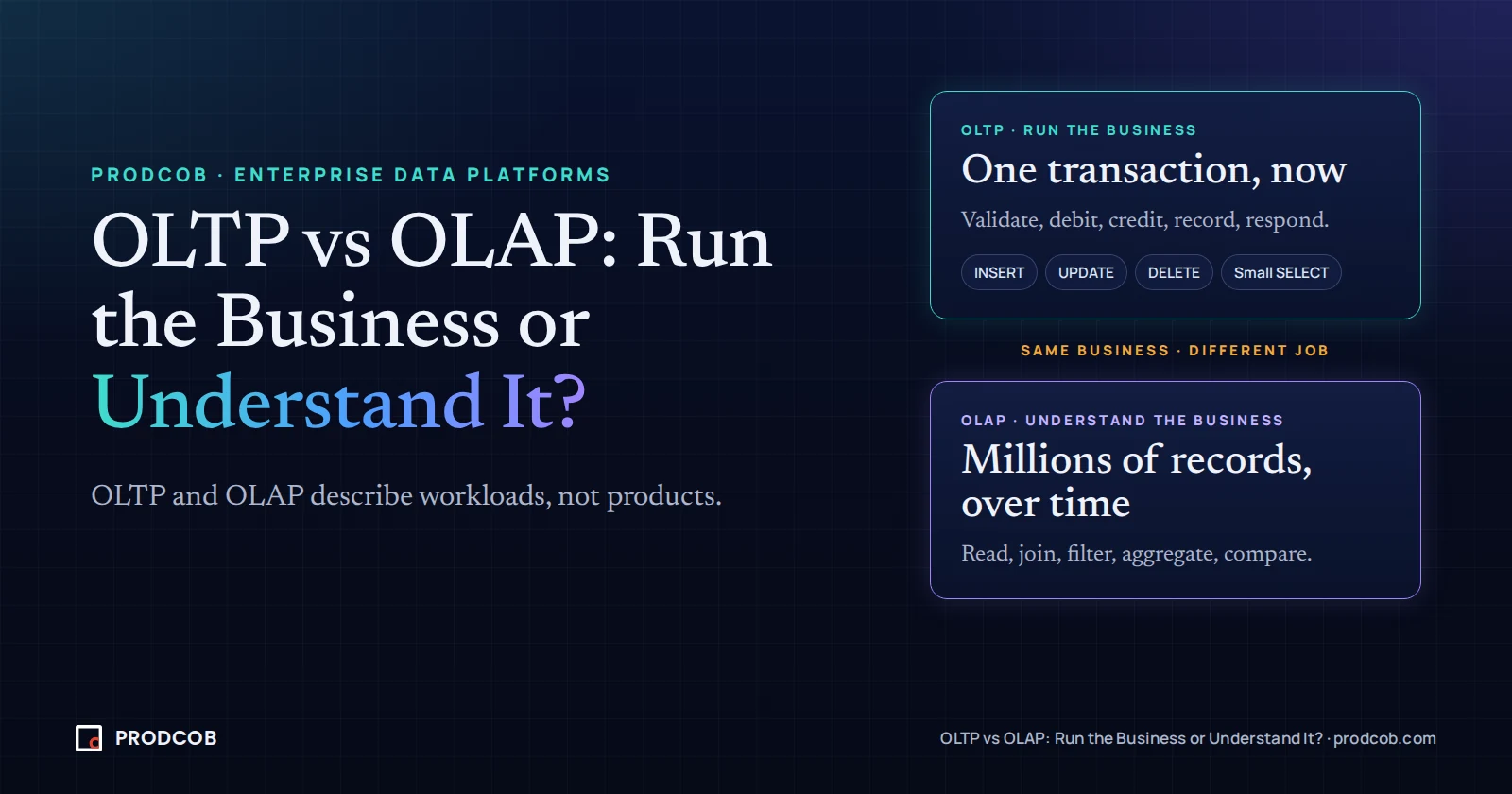
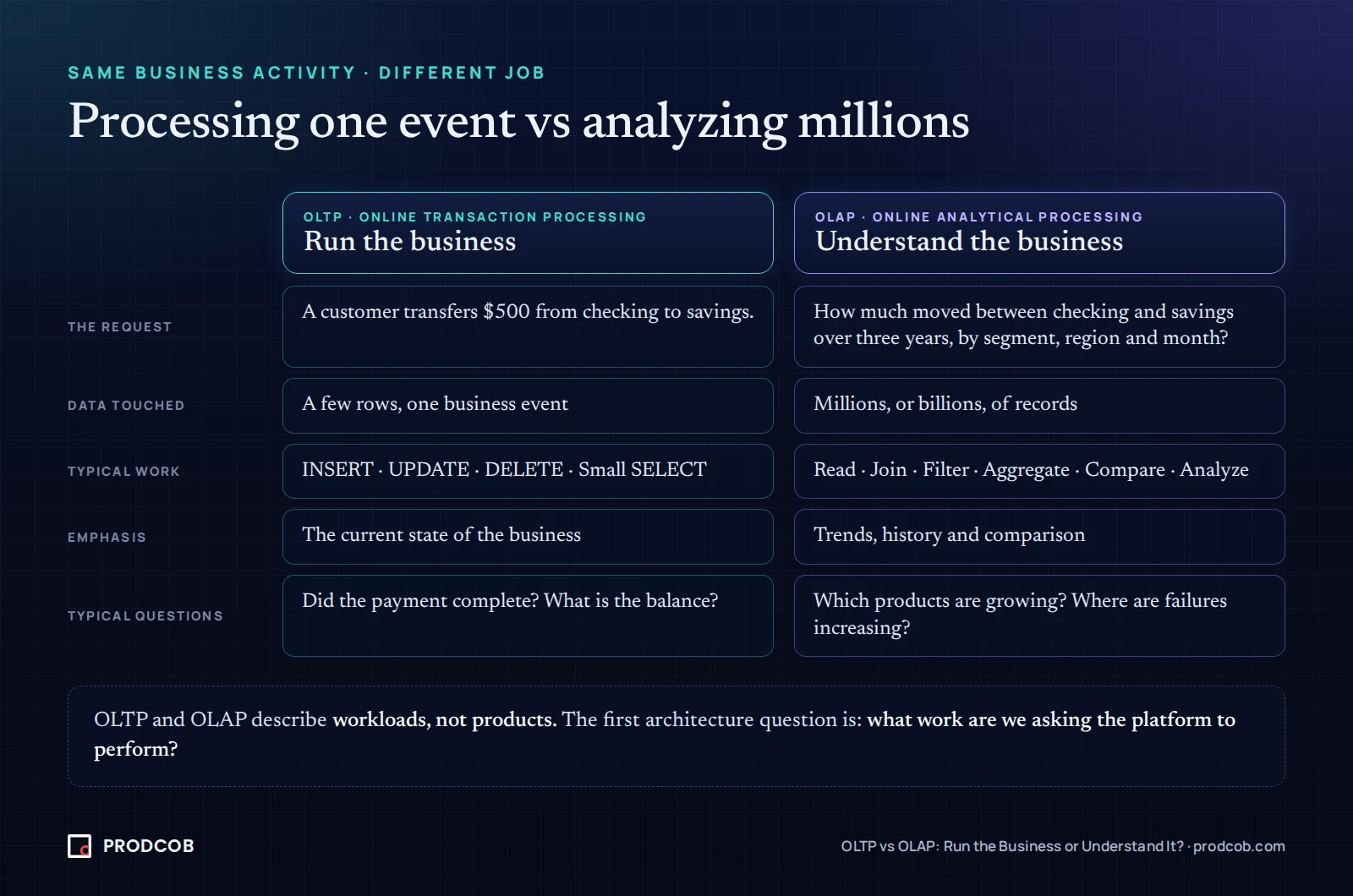
A customer transfers $500 from checking to savings.
At that moment, the technology has a very specific job: validate the request, debit one account, credit another, record the transaction and return a response quickly.
Now imagine an executive asks:
How much money moved between checking and savings accounts over the last three years, by customer segment, region and month?
The data may ultimately come from the same business activity.
But the technology is being asked to do something completely different.
That distinction explains much of modern data architecture.
The simplest mental model is:
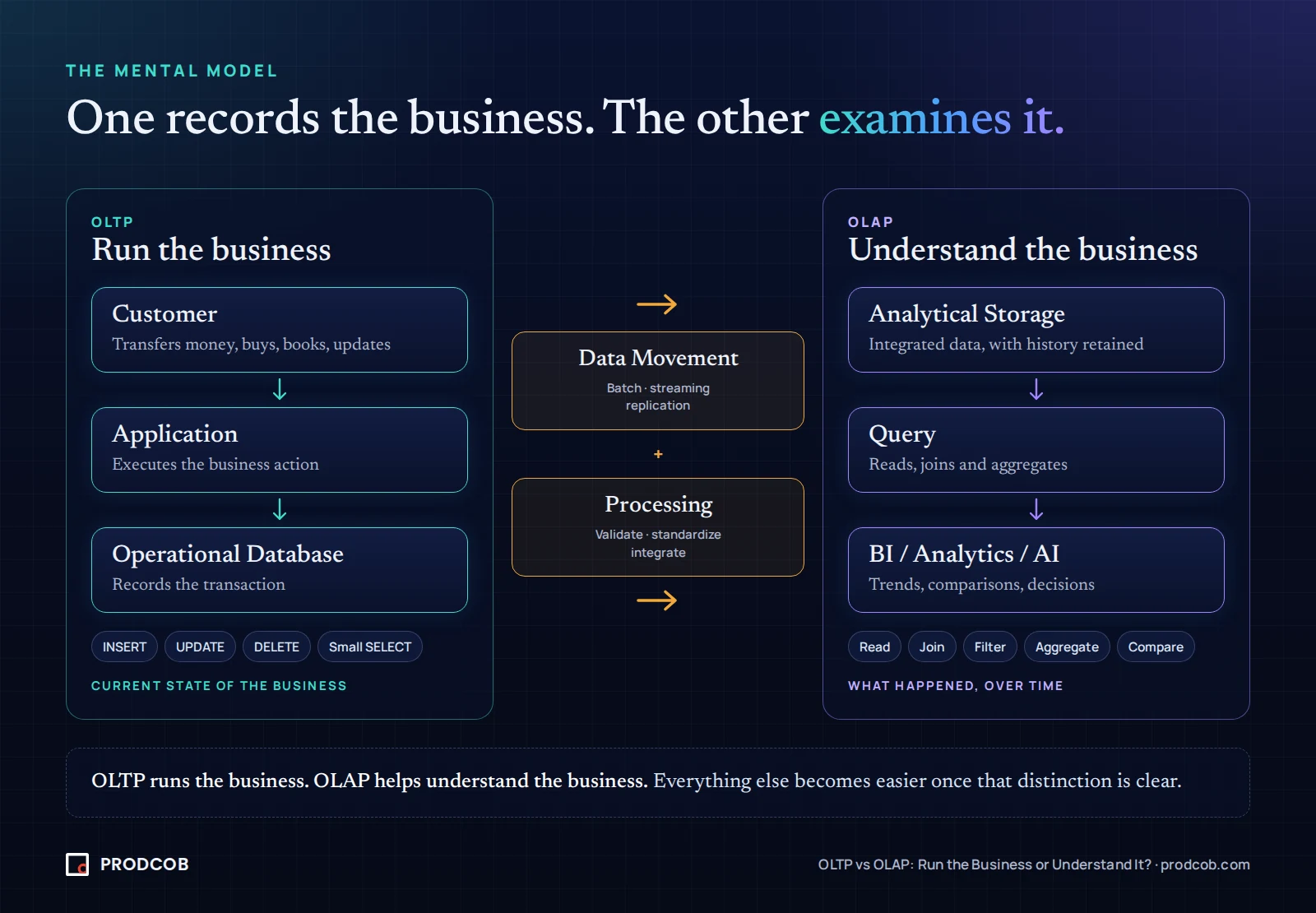
OLTP runs the business. OLAP helps understand the business.
Everything else becomes easier once that distinction is clear.
OLTP: Run the Business
OLTP stands for Online Transaction Processing.
Forget the acronym for a moment.
Think about what happens when someone:
- transfers money;
- purchases a product;
- books an airline ticket;
- changes an address;
- withdraws money from an ATM; or
- creates or updates a record in a business application.
These systems are processing individual business events.
A banking transaction might look like:
Customer → Application → Operational Database
The system needs to process relatively small transactions quickly and reliably.
That normally means a large number of:
INSERT → UPDATE → DELETE → Small SELECT
The emphasis is on the current state of the business.
Did the payment complete?
What is the account balance?
Has the address changed?
Was the order submitted?
That is the OLTP world.
OLAP: Understand the Business
Now change the question.
A risk executive asks:
What percentage of high value transactions were flagged over the last 36 months, broken down by country, product and customer segment?
We are no longer processing one transaction.
We may be reading millions or billions of records.
The work becomes:
Read → Join → Filter → Aggregate → Compare → Analyze
That is the OLAP world: Online Analytical Processing.
OLAP is typically concerned with questions such as:
- What happened over time?
- Where are the trends?
- Which products are growing?
- Where are failures increasing?
- How does one region compare with another?
- What changed from last quarter?
The workload is very different from processing a customer’s payment.
The Mistake: Database = OLTP
A common shortcut is:
Database = transactions
Data warehouse = analytics
It is useful for beginners, but it becomes misleading very quickly.
A database technology is not automatically OLTP.
For example, Oracle Database is a database management system. Depending on how it is designed and used, it can support transactional workloads, analytical workloads or combinations of both.
The more important question is:
What workload are we asking the platform to perform?
That is why executives reviewing architecture should be careful when discussions become dominated by product names.
The architecture decision is not fundamentally:
Oracle vs Databricks vs Snowflake vs something else.
The first question is:
What work are we trying to perform?
Why Enterprises Separate Them
This is where OLTP versus OLAP stops being a technical definition and becomes an architecture decision.
Imagine thousands of customers using a banking application.
At the same time, someone runs a query that needs to:
- scan five years of transactions;
- join customer history;
- join product information;
- group the results across multiple attributes; and
- calculate large aggregations.
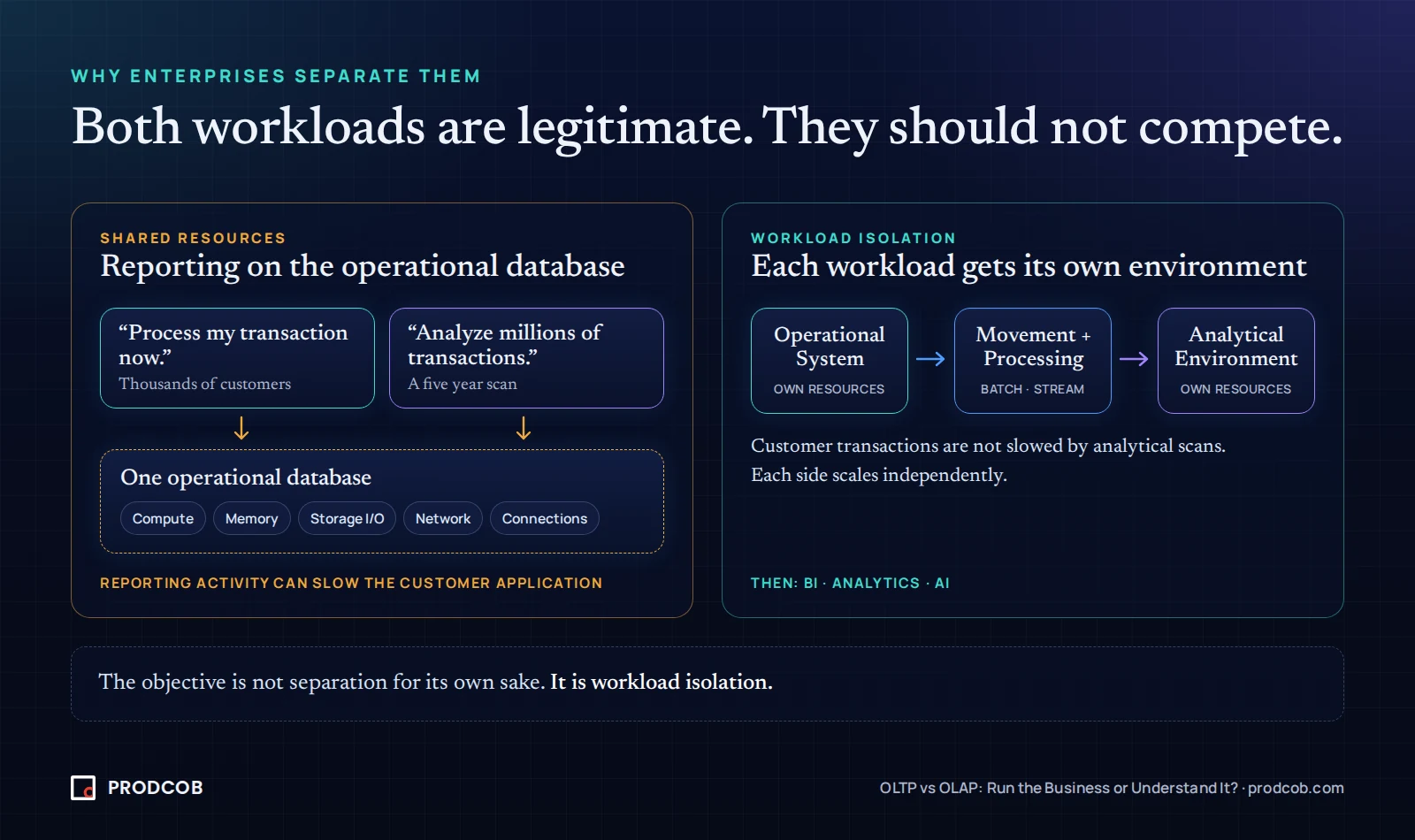
Both workloads need compute, memory, storage I/O, network capacity and database connections.
If they compete for the same resources, reporting activity can affect the performance of the operational application.
That creates an unnecessary conflict.
The customer wants:
Process my transaction now.
The analyst wants:
Analyze millions of transactions.
Both are legitimate requirements.
But they should not necessarily compete for the same resources.
This is one reason enterprises commonly move toward:
Operational System
↓
Data Movement
↓
Processing
↓
Analytical Environment
↓
BI / Analytics / AI
The objective is not separation for its own sake.
It is workload isolation.
Why a Data Warehouse Exists
There is another reason enterprises create analytical environments.
The data usually does not live in one application.
A large organization might have:
Sales + Customers + Inventory + Payments + Risk + Finance
Executives rarely want answers from only one of those systems.
They want questions answered across them.
For example:
Revenue by customer segment, geography, product and quarter.
Answering that repeatedly by querying several operational applications introduces complexity.
An analytical platform can bring those datasets together, standardize them, retain history and make them easier to query consistently.
That is the broader role of a data warehouse.
A warehouse is not simply “a database with fact and dimension tables.”
It is an analytical data environment designed to integrate, retain and serve data for analysis.
Facts and Dimensions Without the Textbook Language
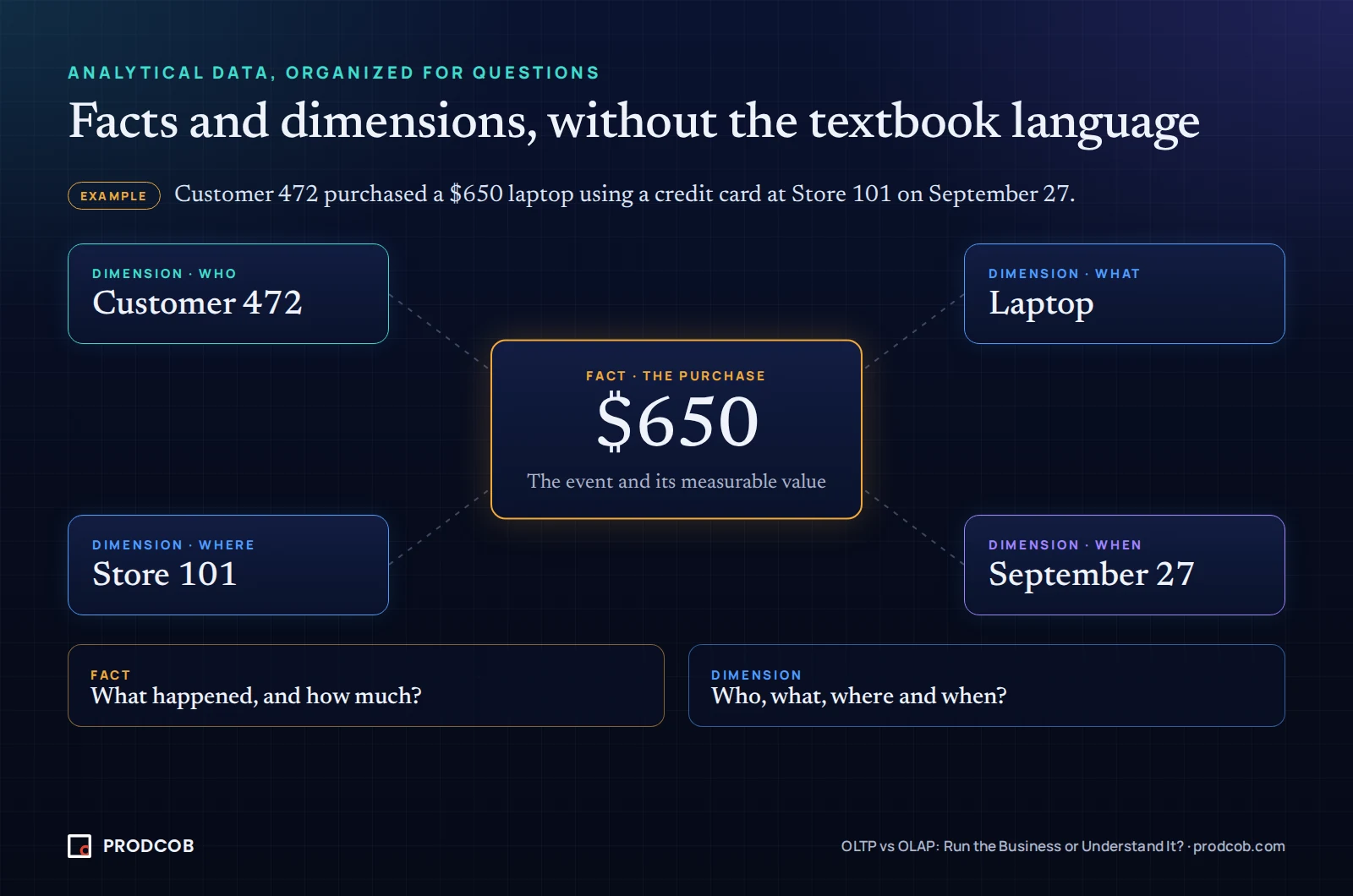
This is where fact and dimension tables become useful.
Suppose:
Customer 472 purchased a $650 laptop using a credit card at Store 101 on September 27.
The event is the purchase.
The measurable value is $650.
That is the type of information we might capture in a fact table.
Now ask:
Who bought it?
What product was purchased?
Where?
When?
Those are dimensions.
A simple way to remember it:
Fact: What happened, and how much?
Dimension: Who, what, where and when?
The important point is not memorizing star schemas.
The important point is understanding why analytical data is sometimes organized differently from operational data.
It is designed to make business questions easier to answer.
Storage Is Not the Same as Analytics
Another distinction becomes important as architectures move into the cloud.
Suppose someone says:
“S3 is our OLAP platform.”
That statement mixes responsibilities.
Object storage such as Amazon S3 or Azure Data Lake Storage can hold enormous amounts of analytical data.
But storage is only one architectural responsibility.
A simplified architecture may contain:
Storage → Processing → Query → Consumption
For example:
Data may be stored somewhere.
A processing engine transforms it.
A query engine reads it.
A BI platform presents it.
Understanding those responsibilities is more useful than memorizing vendor names.
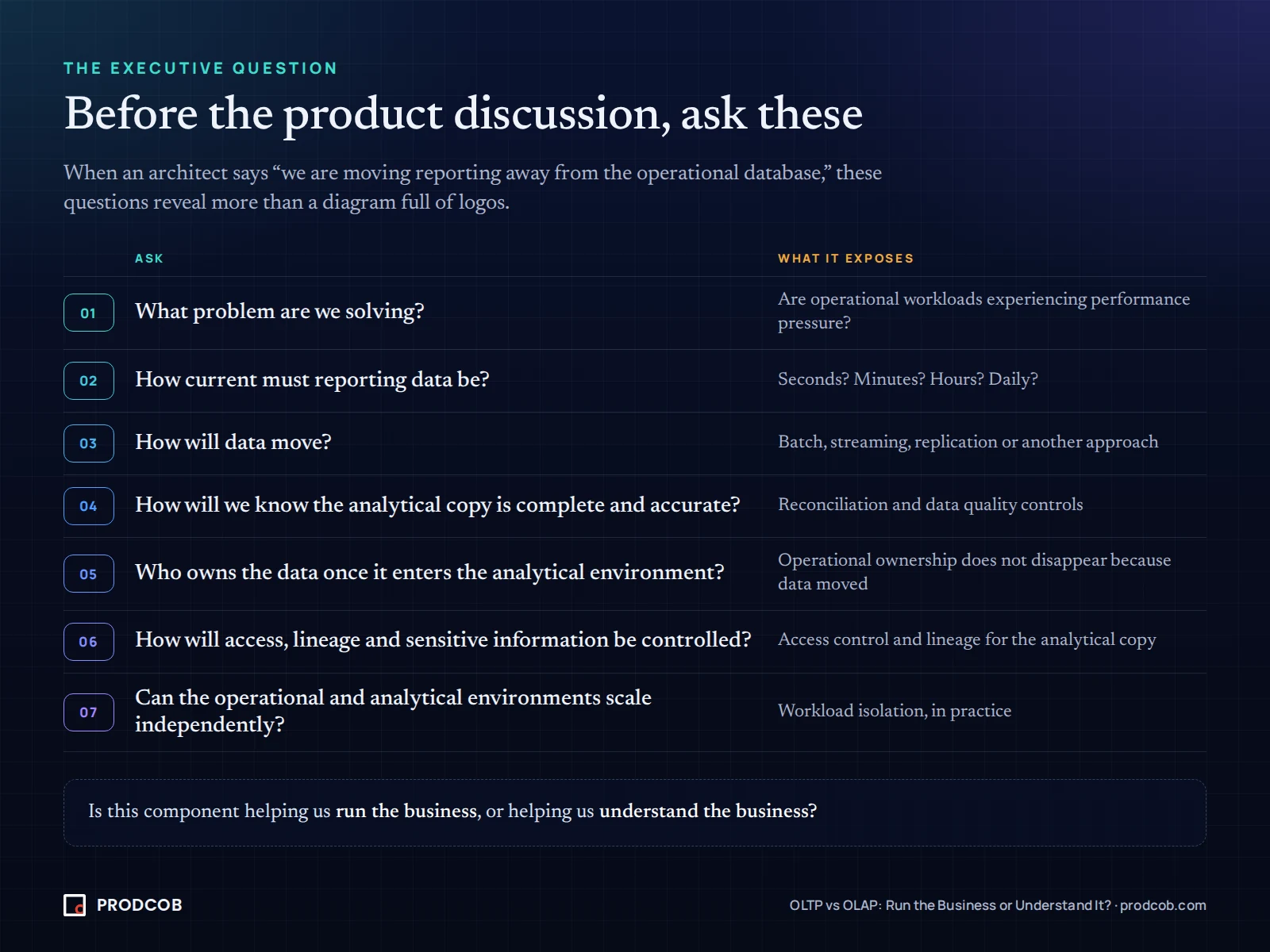
The Executive Question
When an architect says:
“We are moving reporting away from the operational database.”
The executive conversation should not immediately become a product discussion.
Better questions are:
What problem are we solving?
Are operational workloads experiencing performance pressure?
How current must reporting data be?
Seconds? Minutes? Hours? Daily?
How will data move?
Batch, streaming, replication or another approach?
How will we know the analytical copy is complete and accurate?
This introduces reconciliation and data quality controls.
Who owns the data once it enters the analytical environment?
Operational ownership does not disappear simply because data moved.
How will access, lineage and sensitive information be controlled?
And finally:
Can the operational and analytical environments scale independently?
Those questions expose far more about the quality of an architecture than a diagram filled with technology logos.
The Mental Model to Keep
The architecture can ultimately be reduced to this:
RUN THE BUSINESS
Application
↓
Operational Database
↓
Data Movement
↓
Processing
↓
Analytical Storage
↓
Query
↓
BI / Analytics / AI
UNDERSTAND THE BUSINESS
That is the distinction worth remembering.
OLTP and OLAP are not really about competing technologies.
They describe different jobs.
One records individual business activity reliably and quickly.
The other examines business activity across data, history and context.
Good enterprise architecture recognizes that difference and gives each workload the environment, controls and scale appropriate to its purpose.
Executive Takeaway
When reviewing a data architecture, start with a simpler question than “What technology are we using?”
Ask:
Is this component helping us run the business, or helping us understand the business?
Once that answer is clear, decisions about processing, storage, querying, performance, governance and scale become considerably easier.
Related reading on PRODCOB
- Modern Data Architecture: Stop Starting With Technology
- Begin with Databricks: Lakehouse Fundamentals Explained
- Databricks Pipelines: Beyond the Notebook
References
The core workload distinction above is consistent with AWS’s description of OLTP as transaction processing and OLAP as analysis across aggregated data, while Oracle’s own documentation describes OLTP systems as optimized for fast, reliable transaction handling. Microsoft similarly separates ingestion, transformation, modeling and serving responsibilities in modern analytical architectures.
- AWS: What's the Difference Between OLAP and OLTP?
- Oracle: Database Development Guide: Design Basics
- Microsoft Learn: Exploring the Modern Data Warehouse