
Unity Catalog comes up quickly in almost every modern Databricks architecture discussion.
Access control? Unity Catalog.
Lineage? Unity Catalog.
Data classification? Unity Catalog.
Governance? Unity Catalog.
That last answer is where I think the architecture discussion sometimes goes too far.
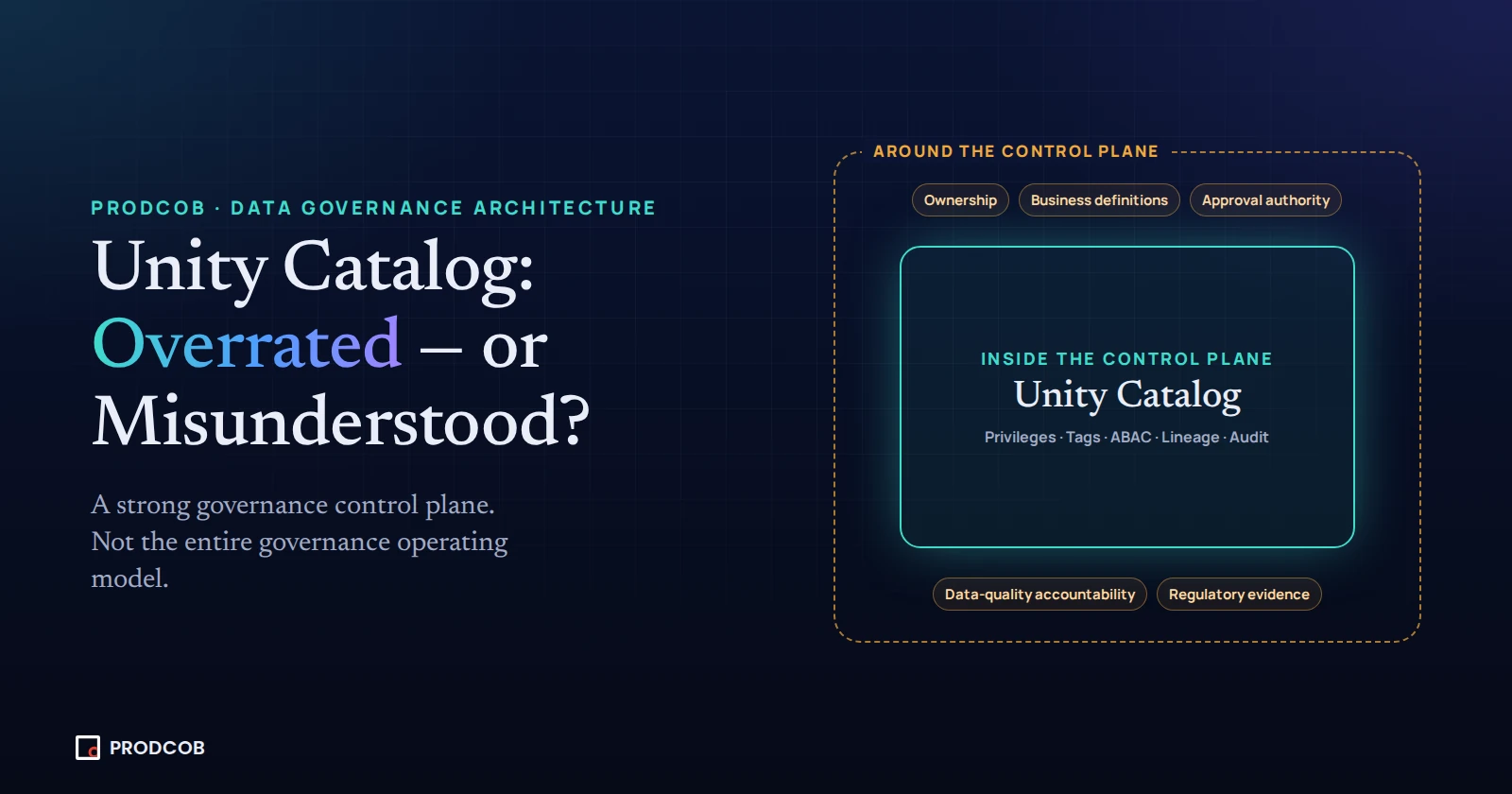
Unity Catalog is a strong governance control plane. It is not the entire governance operating model.
That distinction matters more than the feature list.
What Unity Catalog Actually Does Well
Technically, Unity Catalog has become a substantial part of the Databricks architecture.
It provides a common governance layer across data and AI assets such as tables, views, volumes, functions and models using the catalog.schema.object hierarchy. It also supports centralized privileges, workspace restrictions, governed tags, lineage, auditing, row-level filtering, column masking and attribute-based access control.
ABAC makes the architecture particularly interesting.
Instead of maintaining security independently across thousands of tables, policies can use governed tags and be applied at catalog or schema level. Those policies can dynamically enforce row filters, column masks and supported privilege policies as objects inherit the relevant attributes.
From a Solutions Architect perspective, that is where Unity Catalog earns its place.
You can move toward:
Identity → Policy → Data Classification → Enforcement → Audit
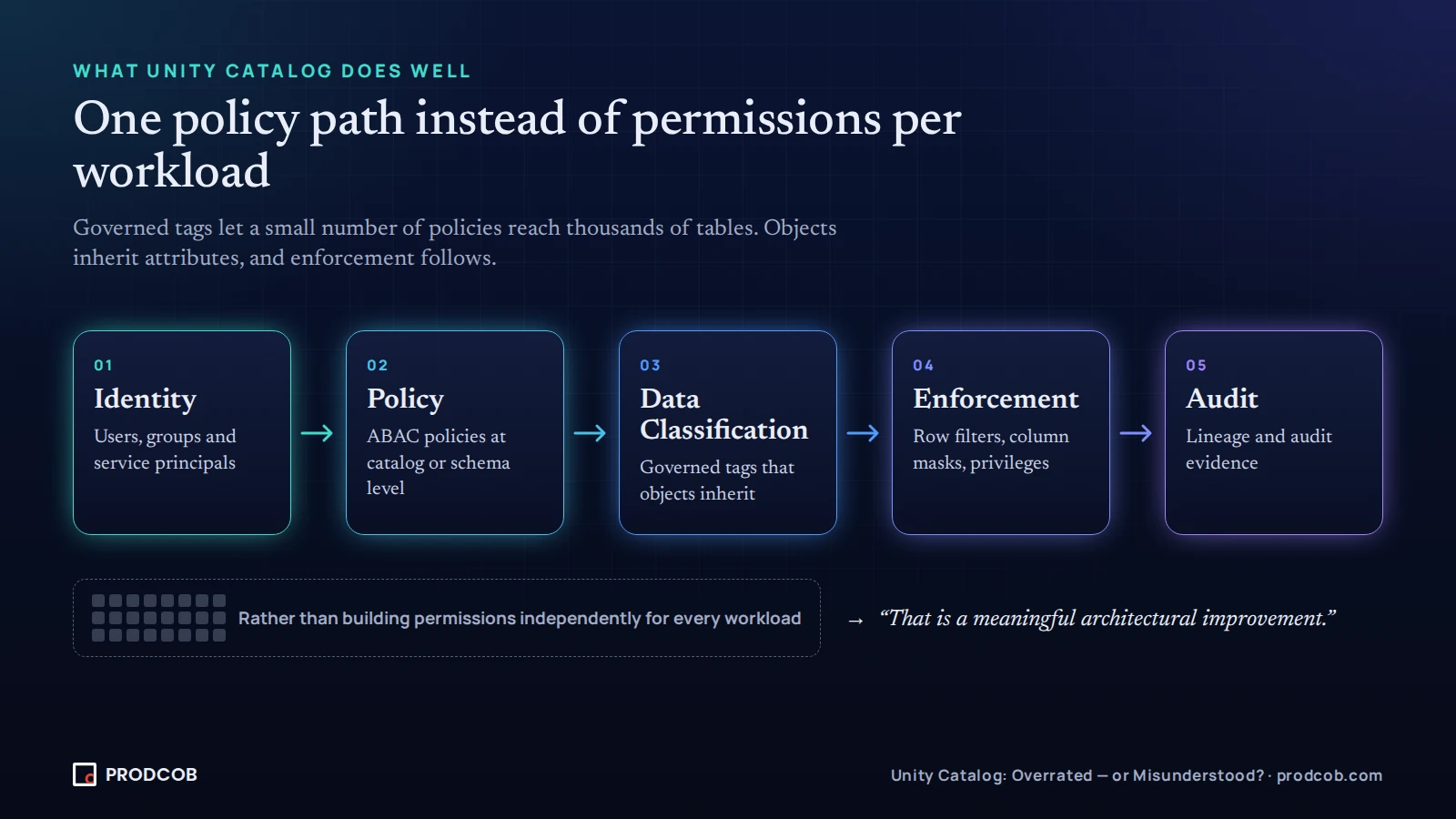
rather than building permissions independently for every workload.
That is a meaningful architectural improvement.
Where the Boundary Starts
The problem is assuming everything around governance now belongs inside Unity Catalog.
It does not.
Take data ownership.
Unity Catalog can technically assign ownership of securable objects. But deciding that Finance owns a customer-risk dataset, determining the accountable executive, resolving conflicting definitions and deciding who accepts a data-quality exception are organizational decisions.
The catalog can enforce the result.
It cannot make the decision.
The same applies to business definitions.
Metadata, descriptions, tags and classifications can be represented within the platform. But agreeing that Customer, Revenue, Exposure or Default has one authoritative meaning across multiple business domains is an enterprise semantic-governance problem.
Again:
Unity Catalog can operationalize governance decisions. It cannot manufacture enterprise consensus.
The Control Boundary Matters
This is the area I would spend more time on during architecture reviews.
Suppose the architecture looks like this:
Entra ID → Databricks → Unity Catalog → Delta Tables
The control path is relatively clear.
Now introduce:
External applications → ADLS → External tables → BI tools → APIs → other processing engines
The question changes.
Which paths still pass through the Unity Catalog enforcement layer?
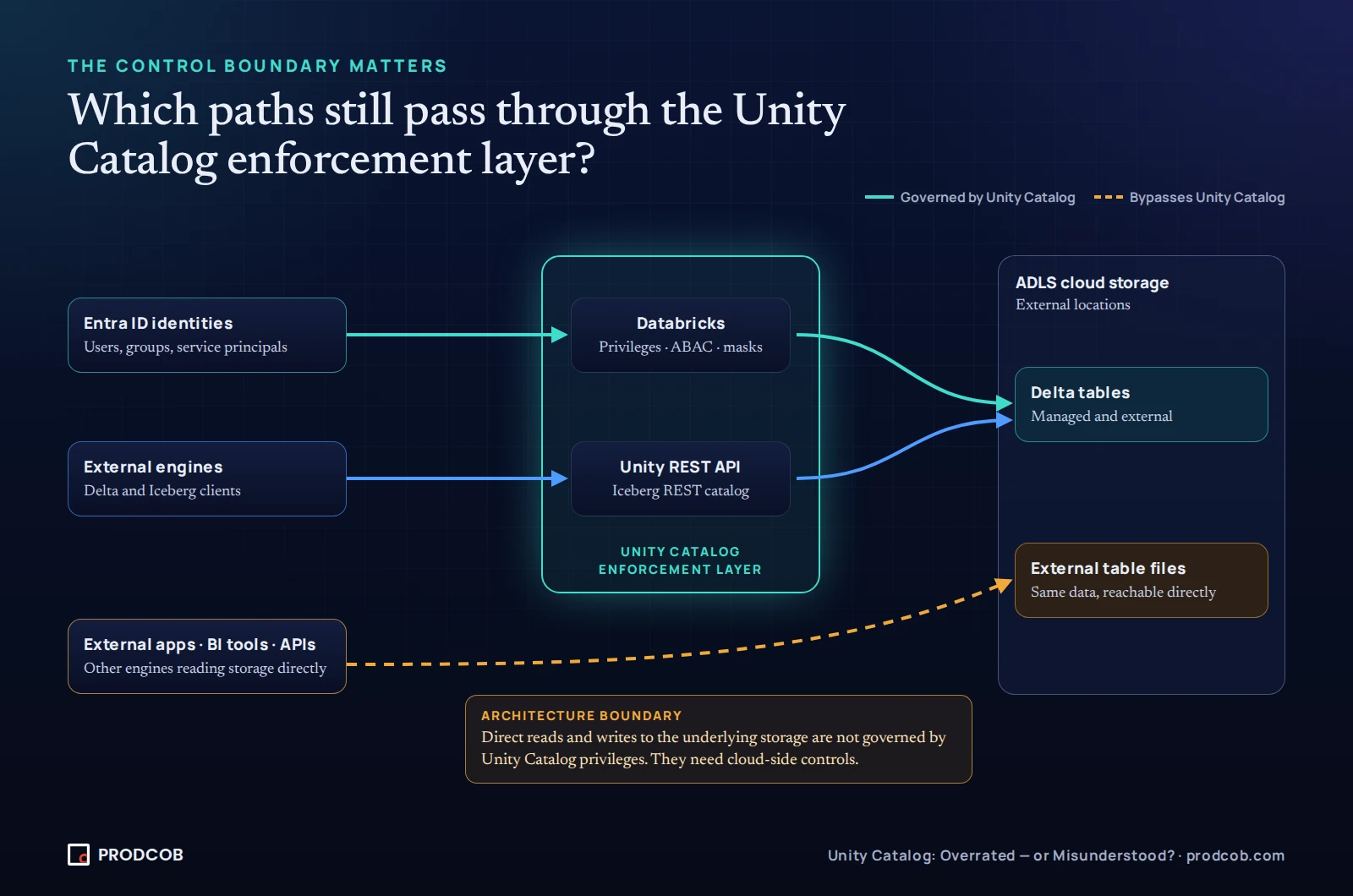
Databricks supports governed external access through mechanisms including Unity REST APIs and Iceberg interfaces. But Microsoft also explicitly notes that when external systems access the underlying cloud storage for external tables directly, Unity Catalog privileges are not enforcing those reads and writes. Additional cloud-side controls are required.
That is not a Unity Catalog weakness.
It is an architecture boundary.
And boundaries are exactly where controls tend to break.
Databricks itself recommends restricting direct access to storage containers configured as external locations because doing so can bypass Unity Catalog access controls.
For me, this is a more useful architecture discussion than simply asking whether Unity Catalog has been implemented.
Access Requests Are Another Good Example
Unity Catalog now supports access-request routing to destinations such as email, Slack, Teams, webhooks and external request-management systems.
That is useful integration.
But an enterprise may still have a broader entitlement lifecycle involving:
Request → Approval → Provisioning → Periodic Certification → Role Change → Revocation → Evidence
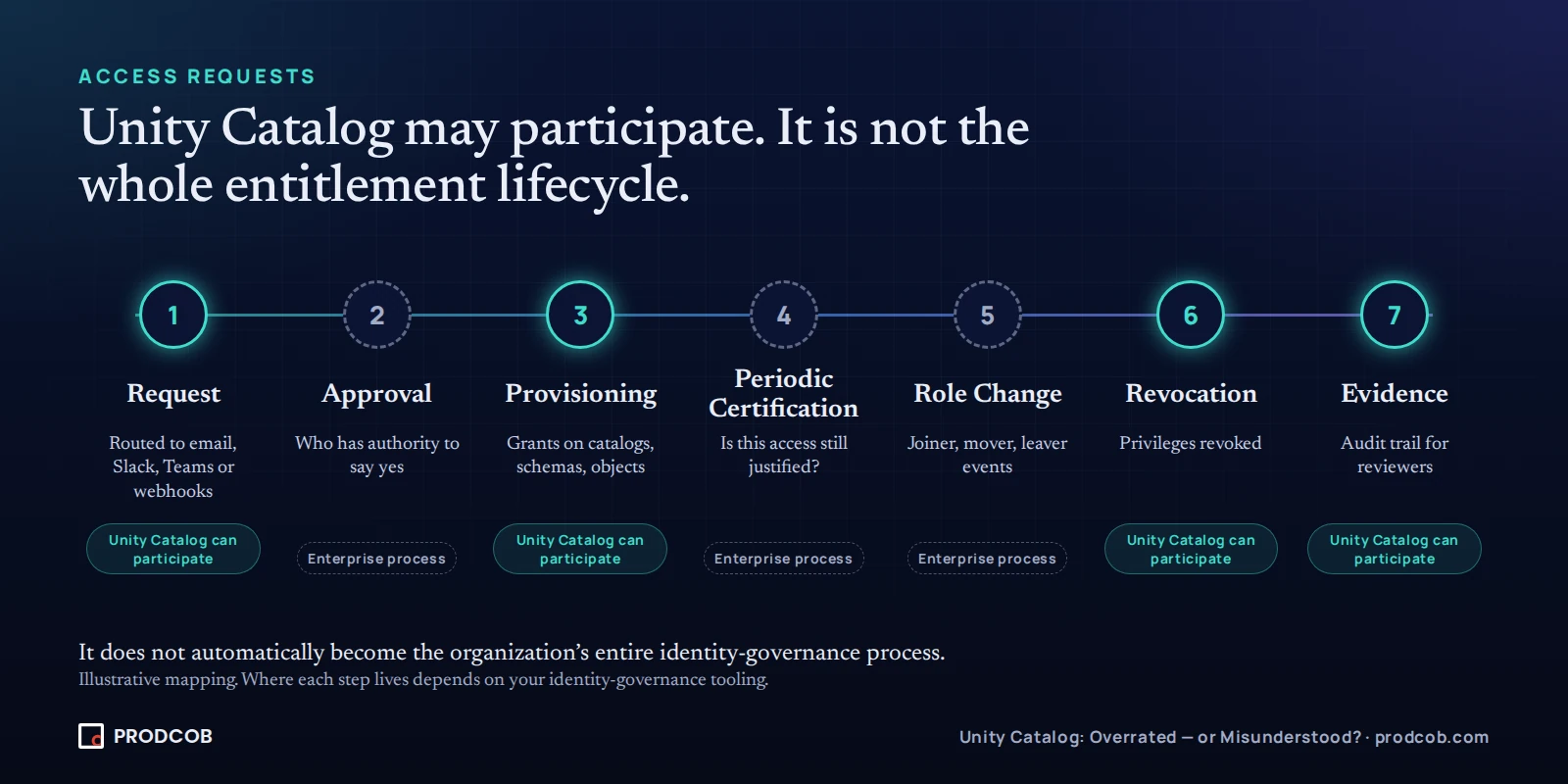
Unity Catalog may participate in that workflow.
It does not automatically become the organization’s entire identity-governance process.
The distinction is subtle, but important.
The Same Applies to Data Quality
Databricks now provides data-quality monitoring and anomaly-detection capabilities within its governance stack.
But detecting a quality issue and being accountable for resolving it are different things.
Technology can tell me:
This dataset changed unexpectedly.
The governance model still needs to answer:
Who owns the issue?
Who determines materiality?
Who accepts the exception?
Who fixes the upstream process?
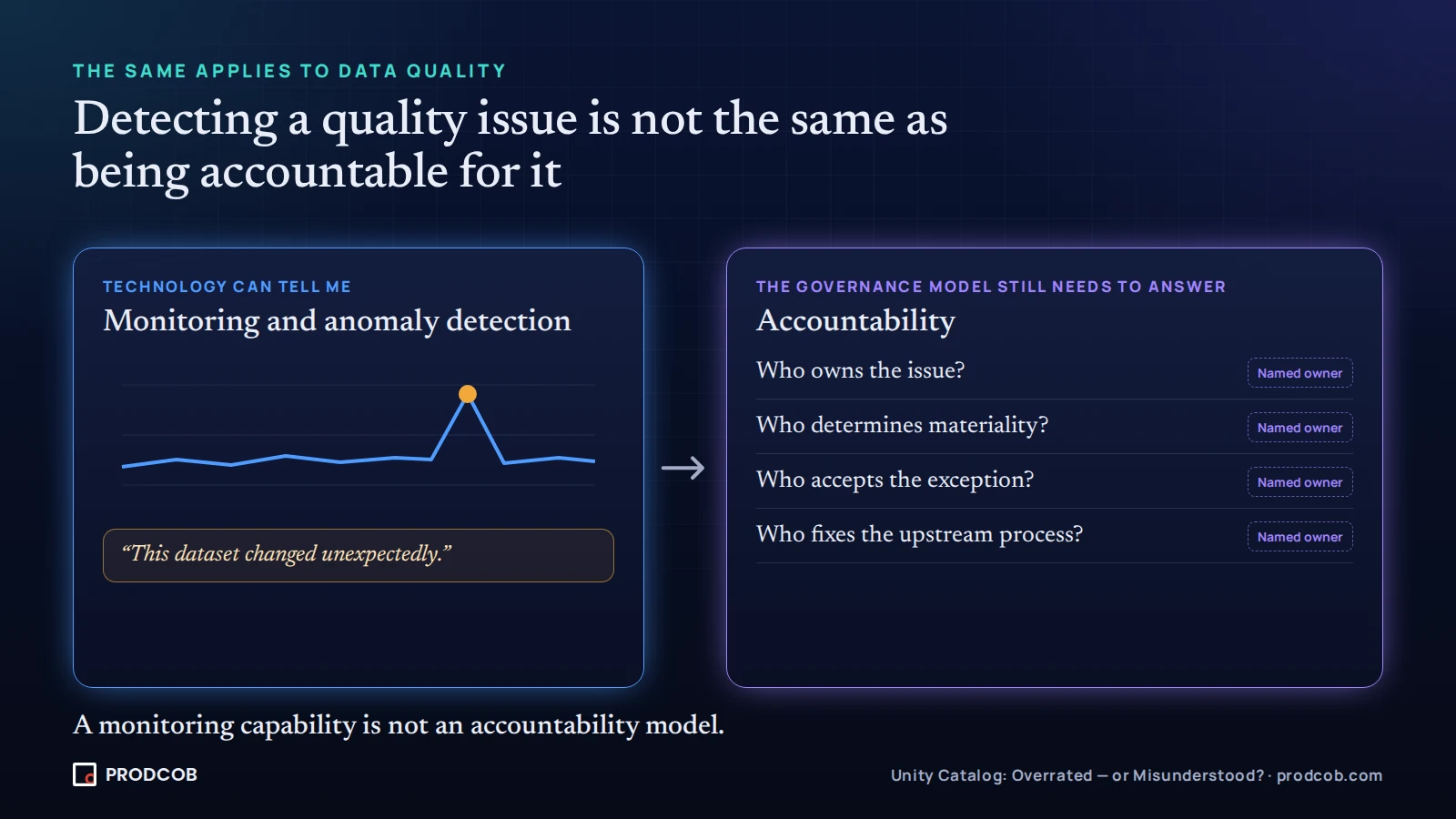
A monitoring capability is not an accountability model.
The Architecture Question I Would Ask
Instead of asking:
“Does Unity Catalog give us data governance?”
I would ask:
What governance decisions do we want Unity Catalog to enforce — and what remains outside its control boundary?
That leads to a much better architecture conversation.
Inside the control plane
Unity Catalog is strong at:
Privileges → Catalogs/Schemas/Objects → Tags → ABAC → Row/Column Controls → Lineage → Audit → Data & AI Assets
Around the control plane
The enterprise still needs to establish:
Ownership → Business Definitions → Approval Authority → Data-Quality Accountability → Regulatory Evidence → Cross-platform Controls
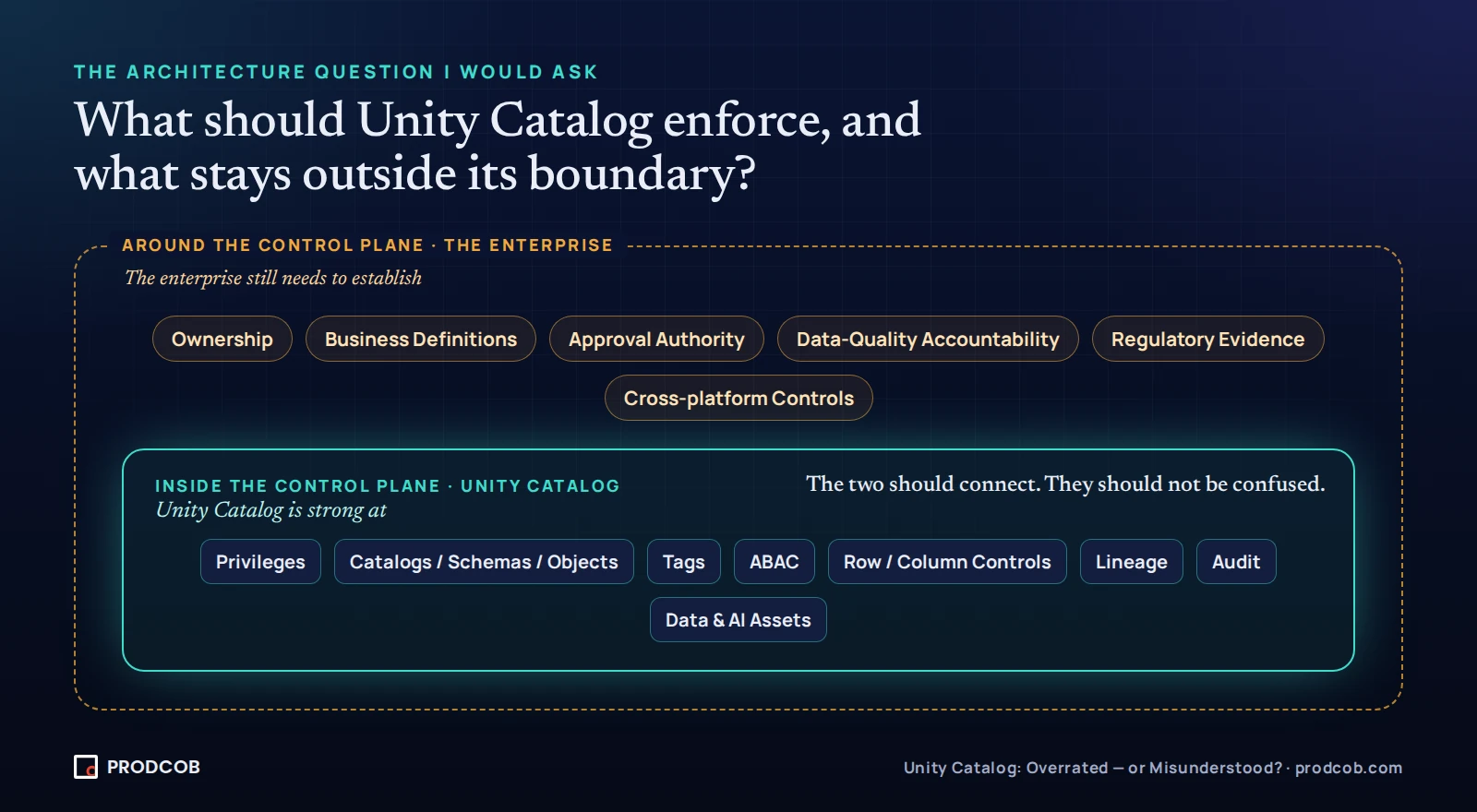
The two should connect.
They should not be confused.
So, Is Unity Catalog Overrated?
As a technical governance layer, no.
It is becoming increasingly capable, particularly as Databricks brings data, analytics and AI assets under a common securable-object and policy model.
But Unity Catalog becomes overrated when an organization expects deployment of the platform to mean the governance problem has been solved.
A well-designed architecture uses Unity Catalog to do what technology does best:
Enforce policy.
Expose lineage.
Centralize controls.
Produce evidence.
And it leaves accountability where it belongs:
with people, processes and clearly defined decision rights.
That is the architecture distinction I would preserve.
Unity Catalog should be designed as the technical enforcement layer of governance — not mistaken for governance itself.
Related reading on PRODCOB
- Begin with Databricks: Lakehouse Fundamentals Explained
- Databricks Pipelines: Beyond the Notebook
- BCBS 239: The Backbone of Risk Data Aggregation & Reporting in Modern Banking
- Identity Is Not Authorization: API Permissions, Access Tokens and Azure RBAC Explained
- DAMA: Data Is No Longer an IT Asset, It’s a Regulated Business Control
References
- Microsoft Learn, Azure Databricks: What is Unity Catalog?
- Microsoft Learn, Azure Databricks: Workspace-catalog binding
- Microsoft Learn, Azure Databricks: Row filters and column masks
- Microsoft Learn, Azure Databricks: Attribute-based access control in Unity Catalog
- Microsoft Learn, Azure Databricks: Governed tags
- Microsoft Learn, Azure Databricks: Lineage in Unity Catalog
- Microsoft Learn, Azure Databricks: Access Databricks data using external systems
- Microsoft Learn, Azure Databricks: Work with external tables
- Microsoft Learn, Azure Databricks: Unity Catalog best practices
- Microsoft Learn, Azure Databricks: Manage access requests
- Microsoft Learn, Azure Databricks: Data quality monitoring